



Solar Panel Price: June 2026
Market Overview
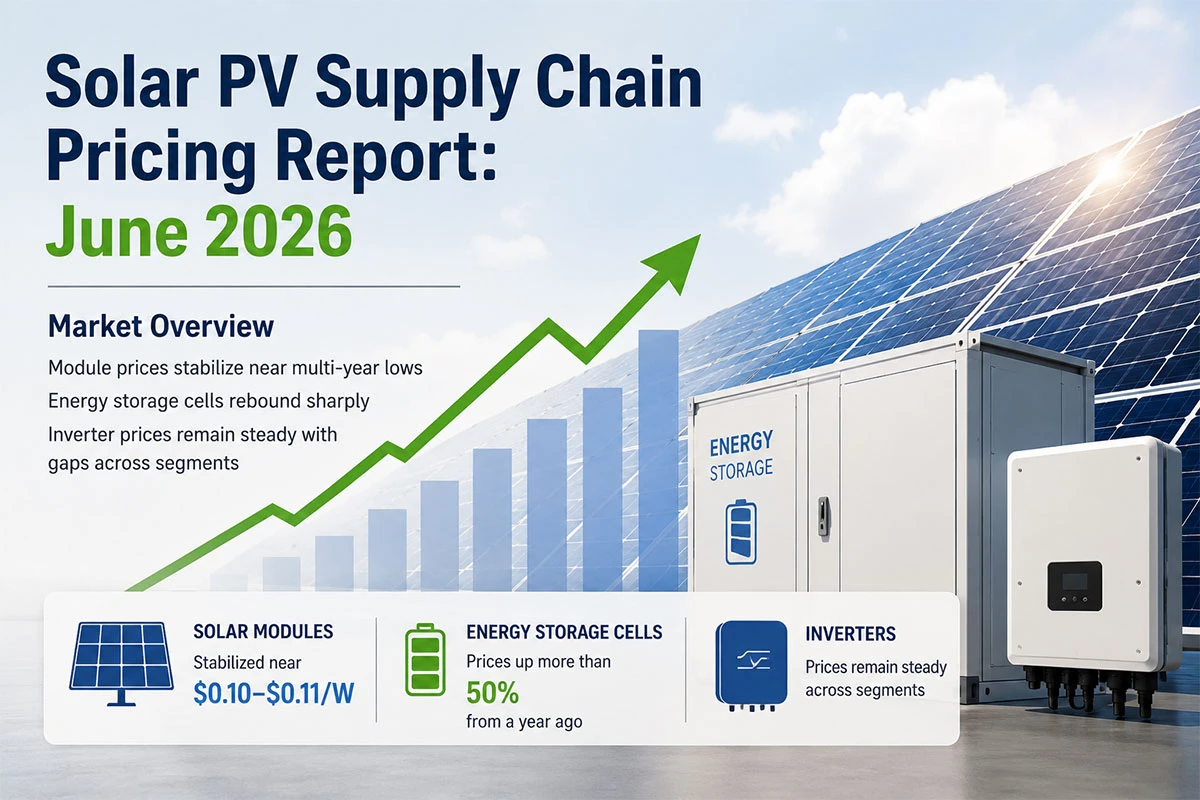
China's solar photovoltaic supply chain continues to show a divided pricing picture heading into mid-2026. While module prices have largely stabilized near multi-year lows after a prolonged downturn, energy storage cells have continued their sharp recovery, with cell prices up more than 50% from the "floor" levels seen a year ago. Inverter pricing has remained comparatively steady, though significant gaps persist across power segments depending on application (residential, commercial & industrial, or utility-scale).
Below is a comprehensive breakdown of pricing across modules, energy storage products, and inverters, based on data compiled from industry sources through mid-June 2026.
1. Solar Module Pricing
After months of price erosion, module prices appear to have found a floor in the $0.10–$0.11/W range for mainstream products, though most manufacturers remain operating near breakeven margins.
| Product Type | Price Range ($/W) | Average ($/W) | Notes |
| TOPCon modules (Tier-1 manufacturers)
| 0.107 – 0.112
| 0.109
| LONGi, JA Solar, Trina and other leading brands
|
| TOPCon modules (Tier-2/3 manufacturers)
| 0.103 – 0.107
| 0.105
| Transaction prices among small/mid-size firms
|
| N-type bifacial TOPCon, 182mm series
| 0.104 – 0.109
| 0.109
| Pricing as of June 12
|
| N-type bifacial TOPCon, 210mm series
| 0.107 – 0.111
| 0.109
| Pricing as of June 12
|
| Average winning bid price (June 1–7)
| -
| 0.112
| Based on 49 tendered projects
|
| Distributed generation guide price
| 0.129 – 0.135
| 0.132
| Distributed channel pricing, e.g. Trina Solar
|
Brand-Specific Module Quotes
Individual manufacturer pricing shows some divergence depending on module wattage and product positioning, with higher-wattage products generally commanding a modest premium.
| Brand / Model | Price ($/W) |
| LONGi 635W
| 0.112
|
| LONGi 620W
| 0.105
|
| JinkoSolar 580W
| 0.102
|
| JinkoSolar 650W
| 0.110
|
| Trina Solar 625W
| 0.108
|
| Tongwei (TW Solar) 625W
| 0.106
|
2. Energy Storage Product Pricing
The energy storage segment tells a markedly different story. Driven by surging demand for grid-scale and commercial/industrial storage systems, combined with a rebound in lithium carbonate prices, lithium iron phosphate (LFP) storage cell prices have risen sharply over the past year.
| Product Type | Price Range ($/Wh) | Notes |
| LFP energy storage cells
| 0.051 – 0.062
| Up more than 20% versus June 2025
|
| Mainstream 314Ah cells
| 0.053 – 0.057
| Leading manufacturers now quoting above $0.06/Wh
|
| 4-hour storage system average
| 0.076
| Market average for the first week of June
|
| 2-hour storage EPC average
| 0.168
| Includes full engineering, procurement and construction
|
Price Trend Analysis
Storage cell prices bottomed out at roughly $0.035/Wh in mid-2025 - a level widely described at the time as a "floor price" driven by severe overcapacity. Since then, prices have climbed by more than 50%, a reversal attributed primarily to two factors:
1. Explosive demand growth - Utility-scale and commercial/industrial storage deployments have accelerated sharply, absorbing excess production capacity that had built up during the 2024-2025 downturn.
2. Lithium price rebound - Recovering lithium carbonate prices have pushed up raw material costs for cell manufacturers, who are now passing some of these increases through to buyers.
The shift represents what several industry commentators describe as a "reversal of the supply-demand relationship" - moving from a buyer's market dominated by oversupply to a market where leading cell manufacturers increasingly have pricing leverage.
3. Inverter Pricing
Inverter pricing has remained the most stable segment of the supply chain, though prices vary significantly by power rating and intended application - residential rooftop, household storage, or commercial/industrial and utility-scale systems.
| Power Rating | Price Range ($/unit) | Notes |
| 3kW single-phase grid-tied
| 382 – 441
| Small residential grid-connected inverter
|
| 3.6kW storage inverter
| 881 – 1,175
| Entry-level residential storage unit
|
| 6kW hybrid inverter
| 1,175 – 1,762
| Off-grid capable storage type
|
| 50kW string inverter
| 1,806
| Government procurement price ceiling
|
| 100kW string inverter
| 3,965
| Government procurement price ceiling
|
| 10–12kW high-power
| 1,762 – 2,643
| Commercial/industrial storage inverter
|

4. Market Outlook
Taken together, the June 2026 data paints a picture of a supply chain moving in three different directions simultaneously:
· Modules: Prices appear to have bottomed in the $0.105–$0.112/W range, with most manufacturers operating near or below cost. Further downside appears limited, but a meaningful recovery would likely require capacity rationalization or a sustained demand surge.
· Energy storage: Prices continue to climb, with cell costs up over 50% from last year's lows. The supply-demand reversal suggests this trend may continue in the near term, particularly if utility-scale storage demand remains robust.
· Inverters: Pricing remains comparatively stable, with clear differentiation by power class and application, and government procurement ceilings providing an anchor for the broader market.
Analysts suggest the energy storage segment will remain the focal point of industry attention in the second half of 2026, while the module segment's ability to break out of its current low-price range will depend largely on the pace of demand recovery and ongoing capacity adjustments across the sector.