



China's Solar Industry Faces Its "Toughest-Ever" Energy Efficiency Rules: The Price-War Era Ends, the Efficiency Era Begins
With the January 1, 2027 deadline approaching, three mandatory national standards are set to reshape competition across China's entire photovoltaic supply chain
Three Mandatory National Standards Take Effect Simultaneously, Covering the Entire Supply Chain
China's photovoltaic (PV) industry is heading into a major restructuring. China's State Administration for Market Regulation and the Standardization Administration of China have officially released three mandatory national standards for the PV sector, which will take effect on January 1, 2027:
GB 29447-2026 - Norm of Energy Consumption per Unit Product for Polycrystalline Silicon and Germanium
GB 47835-2026 - Norm of Energy Consumption per Unit Product for Monocrystalline Silicon
GB 47834-2026 - Minimum Allowable Values of Energy Efficiency and Energy Efficiency Grades for Crystalline Silicon Photovoltaic Modules and Inverters
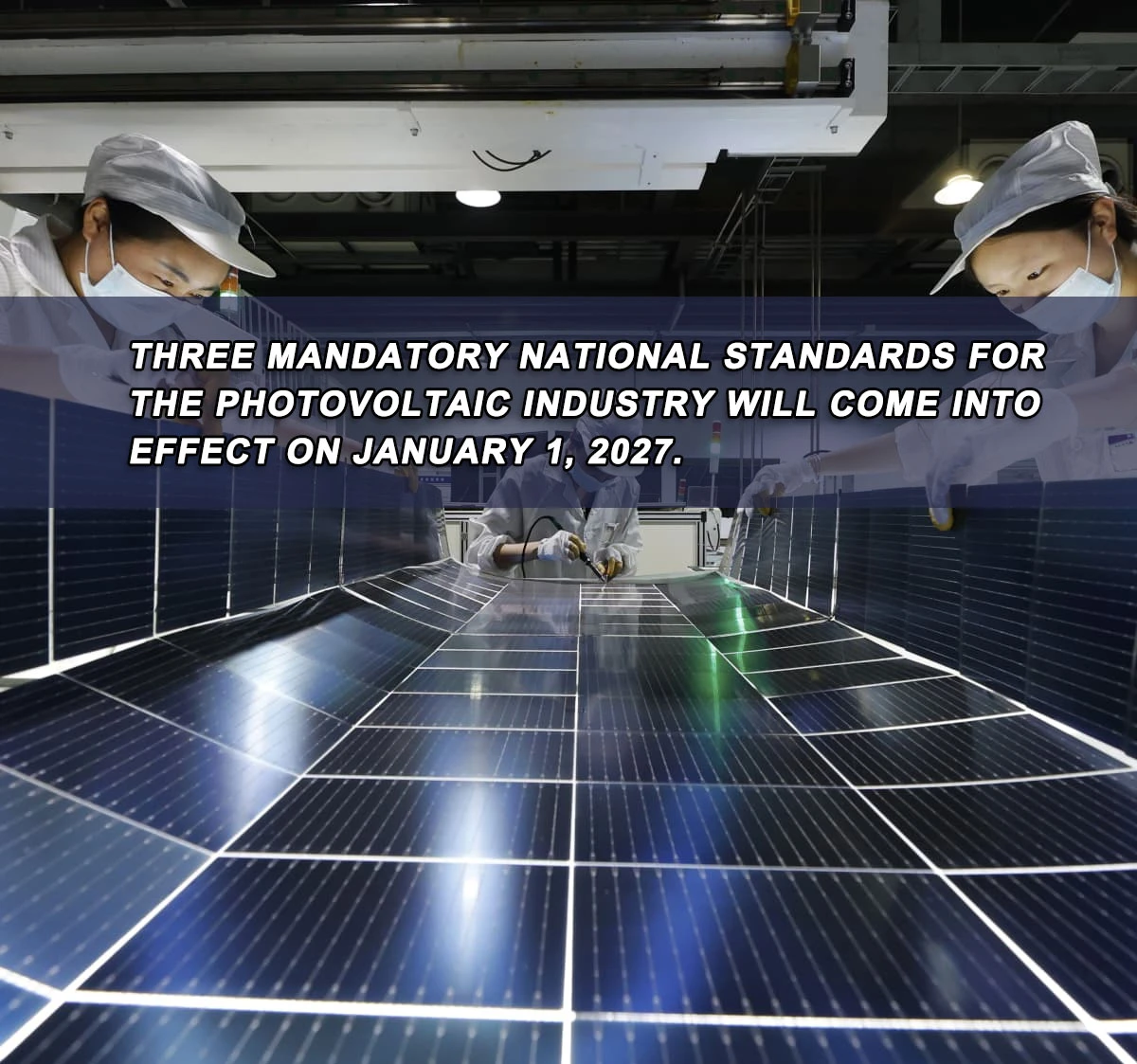
Together, the three standards form a full-chain energy efficiency control system covering the four core segments of PV manufacturing - polysilicon, wafers, modules, and inverters - closing a long-standing gap in mandatory energy-efficiency oversight across the entire PV manufacturing process.
Unlike previous industry standards, which were recommendatory grading guidelines, these new standards carry full legal force. Under the new rules, any product falling below Grade 3 - the minimum market-access threshold - will be barred from production, sale, and import, and will also be excluded from government procurement and bidding for PV projects. This threshold effectively functions as a "line of survival" that will determine which manufacturers remain viable.
Notably, industry sources indicate that as early as February 2026, officials from the Ministry of Industry and Information Technology signaled at a public meeting of the China Photovoltaic Industry Association that the government intended to use high standards to drive high-quality development, and to accelerate the rollout of mandatory national standards - including energy consumption limits - to curb price-based overcompetition ("involution") and quality-control failures within the industry. That policy signal has now materialized into binding national standards.
A Six-Month Transition Window: "Race to the Finish" or "Exit the Market"
The new standards include a transition period between their release and implementation date, during which companies are expected to complete energy-saving retrofits of production lines, obtain product energy-efficiency certification, phase out inefficient capacity, and clear existing inventory.
Industry observers have described this roughly six-month window as the final sprint in an elimination race - after which any capacity that fails to meet the efficiency thresholds will be forced out of the market entirely.
Market Impact: A Fundamental Shift from Price Competition to Technology Competition
The rollout of these standards signals the unwinding of a price-war dynamic that has defined China's PV industry for years. Several key trends are widely expected to follow:
1. Accelerated exit of high-energy-consumption capacity In the polysilicon segment, energy-consumption caps per unit of output will be lowered for both mainstream production routes - the trichlorosilane process and the silane fluidized-bed process - pushing manufacturers to cut costs and energy use through measures such as waste-heat recovery and hydrogen recycling. In the wafer segment, small-scale legacy production lines, older crystal-pulling furnaces, and low-efficiency slicing processes will face significant elimination pressure.
2. Faster phase-out of PERC production lines As a relatively outdated cell technology, PERC production capacity will see its viable market space further squeezed under the new efficiency thresholds.
3. Faster adoption of TOPCon, HJT, and BC cell technologies Next-generation high-efficiency cell technologies are expected to accelerate their replacement of legacy capacity, becoming the industry's mainstream choice under the new policy framework.
4. Inverters brought under mandatory efficiency regulation for the first time Modules and inverters are both classified into three efficiency grades, with Grade 1 representing industry-leading performance, Grade 2 representing more advanced performance, and Grade 3 representing the minimum market-access threshold. Products below Grade 3 will be fully barred from production, sale, and import.
5. The "involution-style" price war is winding down Industry sources note that the standards are unlikely to rebalance supply and demand immediately, and prices for polysilicon, modules, and inverters are unlikely to recover in the short term - structural adjustment of this scale takes time. Even so, the finish line for capacity clearance has now been drawn, and industry competition is shifting from a pure focus on low prices toward a focus on efficiency, quality, and technological strength.
What This Means for Overseas Buyers
The policy shift also carries meaningful implications for global PV supply chains. Industry observers broadly expect the new standards to strengthen the export competitiveness of Chinese PV products, as the industry moves from competing on volume to competing on quality.
For overseas procurement teams, the likely changes include:
Greater supply-chain concentration: As outdated capacity is phased out, leading manufacturers are likely to gain further market share, which should improve supply stability.
Higher product-performance thresholds: The new standards set explicit minimum requirements for module power output and conversion efficiency (for example, minimum power thresholds for mainstream module formats will be raised accordingly), meaning imported modules should see improved average efficiency and better long-term power generation performance.
A shift in negotiating dynamics: The previous model of winning orders primarily through aggressive price-cutting will have less room to operate. Procurement strategy will need to weigh a supplier's technology roadmap, efficiency-grade certification, and long-term reliability more heavily, rather than price alone.
Tighter compliance requirements: Imports are also brought within the scope of the mandatory standards, meaning non-compliant products could face customs clearance and compliance risks going forward.
Conclusion
This industry shift, driven by three newly mandatory national standards, marks China's PV industry formally moving away from an extensive growth model built on price competition and scale expansion, and toward a new cycle driven by efficiency, quality, and technological innovation. As the January 1, 2027 deadline approaches, an industry-wide restructuring centered on technology upgrades and capacity elimination is already underway.
Note: This article is compiled based on publicly available policy information. For specific standard details and implementation requirements, please refer to the official published documents.