



Navigating the New U.S. Section 232 Polysilicon Tariffs: Why Traceable Supply Chains Now Matter More Than Price
- On August 6, 2026, the U.S. administration signed a proclamation imposing a new Section 232 tariff regime on polysilicon and its derivatives, effective December 4, 2026. For solar buyers sourcing cells and modules for the U.S. market, this is not a routine tariff adjustment - it changes how landed cost gets calculated, and it puts supply-chain documentation at the center of every sourcing decision.
[jingsun] is publishing this brief for our customers and partners so they can plan their 2026–2027 procurement with the actual rules in front of them, not headlines.
What Changed
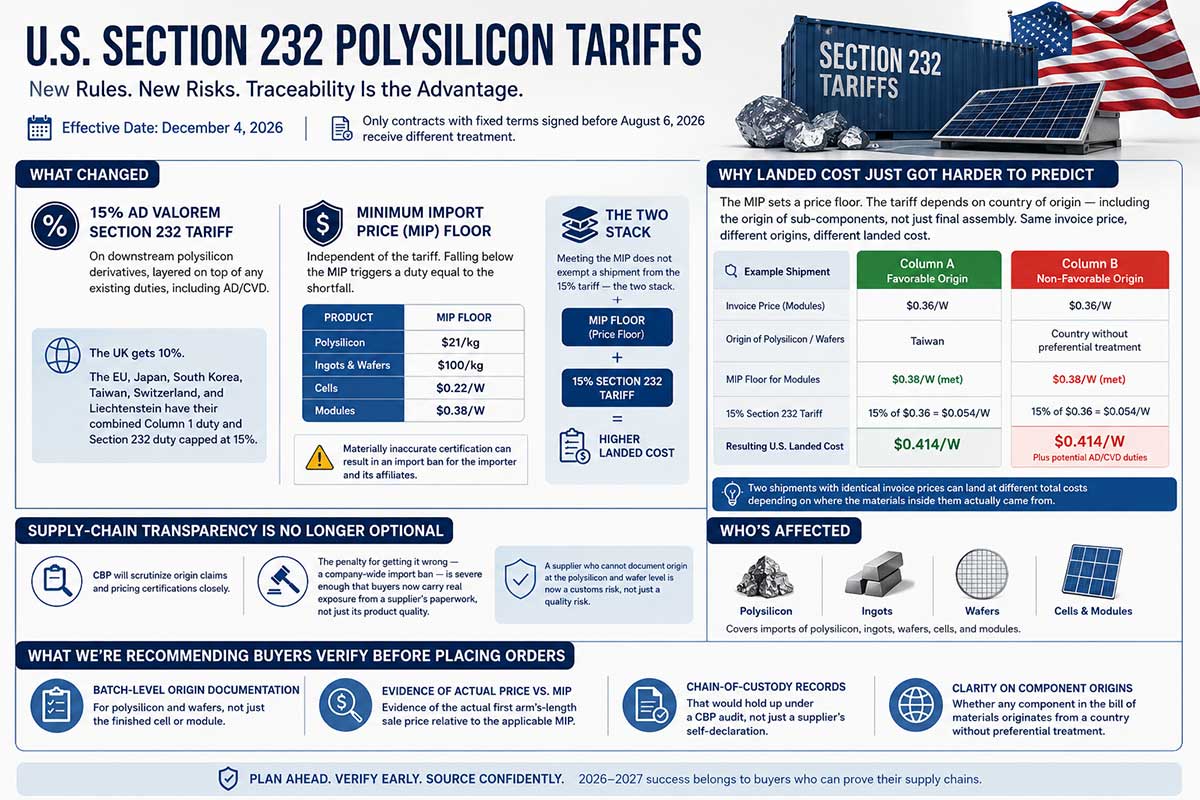
Under the new proclamation, covered imports of polysilicon, ingots, wafers, cells, and modules face two separate mechanisms starting December 4:
A 15% ad valorem Section 232 tariff on downstream polysilicon derivatives, layered on top of any existing duties, including AD/CVD. The UK gets a 10% rate; the EU, Japan, South Korea, Taiwan, Switzerland, and Liechtenstein have their combined Column 1 duty and Section 232 duty capped at 15%.
A Minimum Import Price (MIP) floor, independent of the tariff: $21/kg for polysilicon, $100/kg for ingots and wafers, $0.22/W for cells, and $0.38/W for modules. Falling below the MIP triggers a duty equal to the shortfall; materially inaccurate certification can result in an import ban for the importer and its affiliates.
Meeting the MIP does not exempt a shipment from the 15% tariff - the two stack. Only contracts with fixed terms signed before August 6, 2026 receive different treatment.
Why Landed Cost Just Got Harder to Predict
The MIP effectively sets a price floor regardless of what a supplier actually charges, while the tariff rate depends on country of origin - including the origin of sub-components inside a module, not just the module's final assembly location. Two shipments with identical invoice prices can now land in the U.S. at different total costs depending on where the polysilicon, ingots, and wafers inside them actually came from. For buyers, that means the sourcing question is no longer just "what's the price" - it's "can this price and this origin be proven."
Supply-Chain Transparency Is No Longer Optional
CBP has signaled it will scrutinize origin claims and pricing certifications closely, and the penalty for getting it wrong - a company-wide import ban - is severe enough that buyers now carry real exposure from a supplier's paperwork, not just its product quality. This is the practical reason supply-chain transparency has moved from a compliance checkbox to a commercial requirement: a supplier who cannot document origin at the polysilicon and wafer level is now a customs risk, not just a quality risk.
What We're Recommending Buyers Verify Before Placing Orders
Before signing 2026–2027 supply agreements, we'd suggest asking every prospective supplier for:
Batch-level origin documentation for polysilicon and wafers, not just the finished cell or module
Evidence of the actual first arm's-length sale price relative to the applicable MIP
Chain-of-custody records that would hold up under a CBP audit, not just a supplier's self-declaration
Clarity on whether any component in the bill of materials originates from a country without preferential treatment under the proclamation
Procurement Strategy for 2026–2027
A few practical implications for buyers planning shipments into the U.S. market over the next two years:
Ask early, not at the port. Origin and pricing documentation takes time to assemble properly. Requesting it during contract negotiation gives a supplier room to produce it correctly; requesting it after a shipment has sailed does not.
Treat documentation as a contract term, not a side request. Buyers may want to specify in purchase agreements exactly what origin and pricing evidence a supplier is expected to provide, and build in the right to audit it.
Diversify with origin in mind, not just capacity. A supplier with spare capacity in a favorable-tariff country is only useful if the polysilicon and wafers inside its product actually originate there - the bill of materials matters as much as the factory's address.
Watch how MIP levels move. The proclamation allows Commerce to adjust minimum import prices over time, so 2026–2027 sourcing contracts should build in some flexibility rather than assuming the current floors are fixed for the full period.
Model cost scenarios now. Because the tariff and MIP interact differently depending on origin and component sourcing, it's worth running landed-cost estimates under a few different supplier scenarios before committing to volume, rather than after.
None of this is a reason to slow down 2026–2027 planning - it's a reason to ask better questions of every supplier on the table, including us.