



Thailand Solar Policy 2026: New Incentives Boost Rooftop Solar and C&I Energy Storage
Thailand's solar market entered 2026 with three overlapping policy moves landing within months of each other: a formally enacted personal income tax deduction for home solar, the reopening of a residential electricity buy-back scheme that had been frozen since 2024, and a set of Board of Investment (BOI) incentives that reward renewable power projects and - more selectively - battery storage. None of these measures is new in concept, but their combined timing is pushing the market's center of gravity away from simple panel sales and toward integrated solar-plus-storage systems for homes, factories and commercial buildings.
For international suppliers, the practical question is not whether Thailand's solar market is growing - it clearly is - but which parts of the value chain the new rules actually reward, and where the real opportunity for PV, inverter, battery and energy management (EMS) business now sits.
What Changed?
Three separate instruments make up the current policy package, and they should not be conflated.
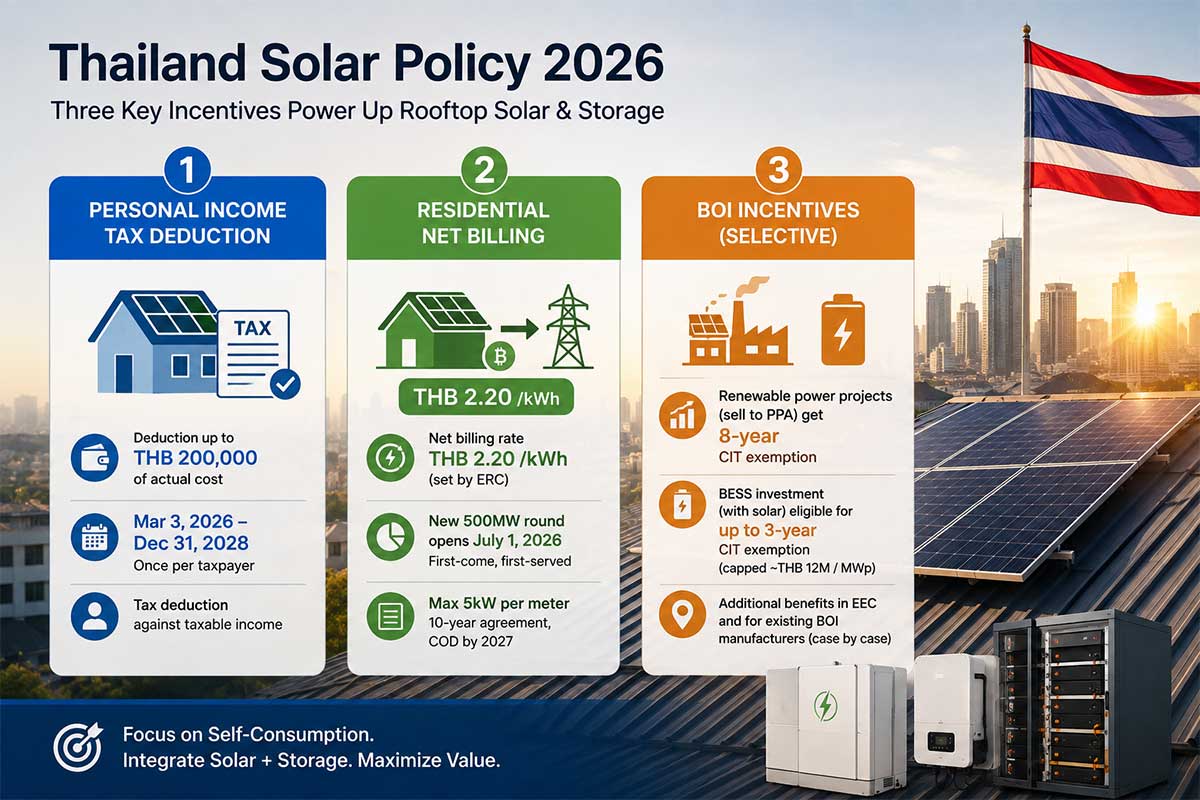
1. A confirmed personal income tax deduction.
Royal Decree No. 805 (B.E. 2569), published in the Royal Gazette on March 2, 2026, grants individual taxpayers a deduction equal to the actual purchase and installation cost of an on-grid rooftop solar system, capped at THB 200,000. The measure runs from March 3, 2026 through December 31, 2028, and can be claimed once per taxpayer, in the tax year the system is connected to the grid operated by MEA or PEA. Eligibility requires the taxpayer's name to match the electricity meter registration and a valid e-Tax invoice from a VAT-registered supplier. This is a tax deduction against taxable income, not a cash rebate or a tax credit - its value scales with the taxpayer's marginal tax bracket.
2. A residential net billing rate, not a feed-in tariff.
Exported electricity from qualifying residential rooftop systems is compensated under a net billing mechanism at THB 2.20/kWh, a rate the Energy Regulatory Commission (ERC) set in 2022. This is meaningfully lower than Thailand's retail electricity tariff, and imported grid electricity continues to be billed at the full retail rate - the arrangement rewards self-consumption far more than export. The original combined MEA/PEA purchasing quota of roughly 90MW was filled by late 2024, after which new applications were frozen; that freeze lifted on July 1, 2026, with a new 500MW round now open on a first-come, first-served basis, capped at 5kW per meter, under 10-year agreements, with commercial operation required by 2027. It is a net billing scheme, not a universal feed-in tariff, and the quota-based structure means timing matters for anyone advising residential customers.
3. BOI incentives that apply selectively, not automatically.
The Board of Investment's Category 7.1 (A2) covers electricity generation from renewable sources, including solar, and grants an 8-year corporate income tax exemption plus import duty relief on qualifying machinery. Critically, this incentive is built around projects that generate and sell power - typically under a PPA with EGAT, PEA or MEA, or solar systems built within an already BOI-promoted industrial project. A standalone rooftop system installed purely for a factory's own self-consumption, with no power sale structure, generally does not qualify on its own. Separately, BOI has a narrower provision specifically for battery energy storage investment paired with solar: eligible BESS investment (capped around THB 12 million per MWp) can receive its own incentives, including up to a 3-year corporate income tax exemption - but this benefit applies to the storage component, not the solar panels. Additional stacking mechanisms exist for factories located in the Eastern Economic Corridor and for existing BOI-promoted manufacturers investing in on-site solar under energy-efficiency provisions, but these vary by project structure and location and should be confirmed case by case rather than assumed.
|
Policy |
Target |
Key Benefit |
Business Impact |
|
Net billing for residential solar export |
Residential systems (currently capped at 5kW per meter under the reopened 500MW round) |
THB 2.20/kWh for exported electricity under 10-year agreements |
Self-consumption remains far more valuable than export; system sizing should prioritize daytime load matching over export capacity |
|
Royal Decree No. 805 – personal income tax deduction |
Homeowners installing on-grid rooftop solar |
Deduction of actual cost, capped at THB 200,000, claimed once, in the year of grid connection |
Shortens effective payback for owner-occupied residential systems; requires e-Tax invoice documentation |
|
BOI Category 7.1 (A2) – renewable power generation |
Companies developing solar projects with a power sale structure (PPA) or within a promoted industrial project |
8-year corporate income tax exemption, largely uncapped, plus import duty exemption on qualifying machinery |
Major driver for utility-scale and structured C&I solar investment decisions |
|
BOI battery storage incentive |
Companies pairing solar with a qualifying BESS investment |
Incentives (up to 3-year CIT exemption) applied to the storage investment specifically, capped around THB 12 million/MWp |
Directly improves the economics of adding storage to an existing or planned solar project |
Why C&I Solar Matters
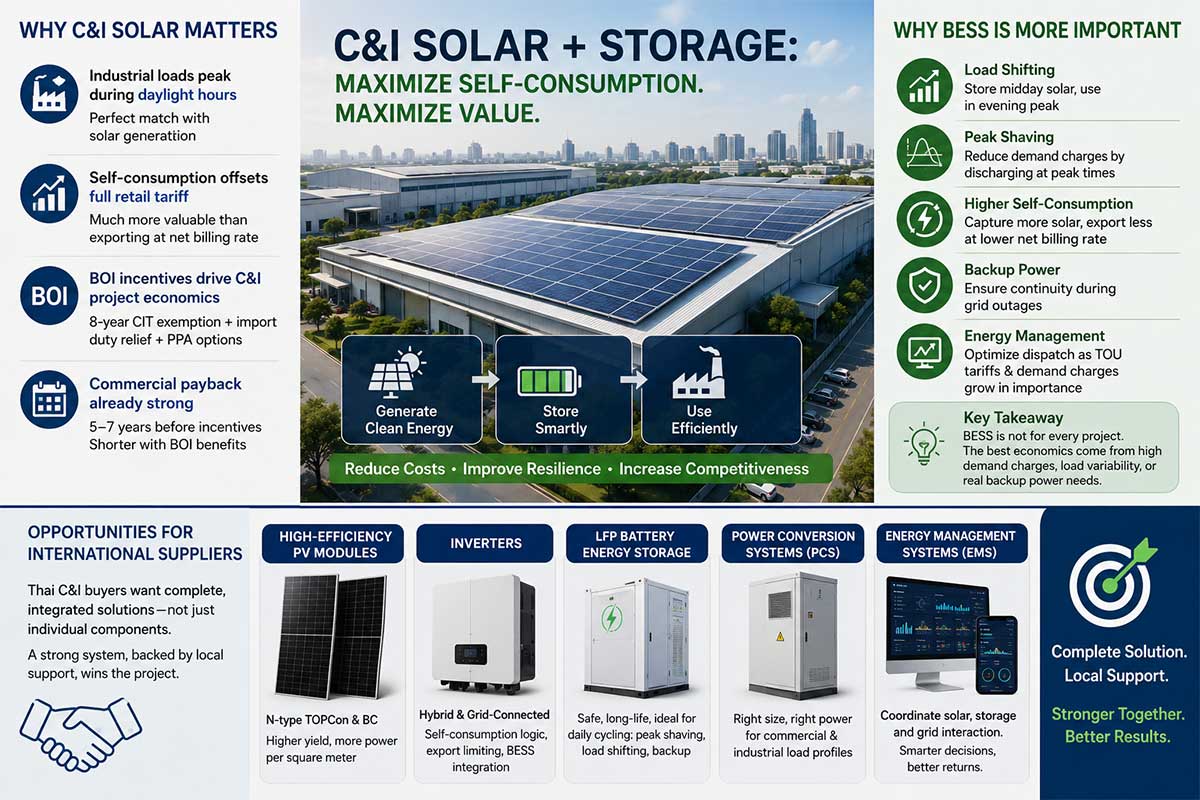
Thailand's industrial base is exactly the kind of load profile that rooftop solar is built for. Factories, warehouses, hotels, shopping centers, automotive plants and electronics manufacturers typically run their heaviest electricity draw during daylight hours - production lines, cold storage, HVAC and lighting in commercial buildings all peak when solar generation is also at its highest. That overlap between generation and consumption is the single biggest reason C&I solar economics in Thailand tend to outperform residential ones: a factory that self-consumes most of its solar output is effectively offsetting purchase at the full industrial retail tariff, not selling into a discounted net billing rate.
This is also why the BOI's structured incentives matter more to C&I buyers than the residential tax deduction does. A factory evaluating a 1-5MW rooftop or ground-mount system is not primarily thinking about a THB 200,000 personal deduction - it is running a 15-to-25-year cash flow model where an 8-year CIT exemption, import duty relief on inverters and racking, and (where applicable) a PPA structure with the local utility can materially shift the payback period. Thailand's module prices, which fell into the USD 0.10–0.12/W range in recent years, have already compressed commercial payback windows into the five-to-seven-year range even before incentives; BOI treatment can shorten that further for qualifying projects.
Why BESS Is Becoming More Important
The core economic logic in Thailand's current tariff structure is simple: self-consumption is worth more than exported electricity. Net billing pays THB 2.20/kWh for exports while grid imports are billed at full retail rates that run well above that figure. For any solar system - residential or commercial - the financial incentive is to consume as much on-site generation as possible and export as little as possible.
That is precisely the gap battery storage is positioned to close. For C&I customers in particular, BESS can support:
Load shifting - storing midday solar surplus for use during evening peak demand
Peak shaving - reducing demand charges by discharging batteries during a facility's highest-draw periods
Higher solar self-consumption - capturing generation that would otherwise be exported at the lower net billing rate
Backup power - providing continuity during grid outages, a relevant consideration for manufacturers running continuous processes
Energy management - enabling more sophisticated dispatch strategies as time-of-use tariffs and demand charges become more significant cost factors
It is worth being direct about the limits here: BESS is not automatically economical for every solar project in Thailand today. Battery costs, a facility's specific load curve, and whether a project can access the BOI's storage-specific incentive all affect the payback calculation, and a system with a flat, low daytime load may see little benefit from adding storage. The projects where BESS makes the strongest financial case tend to be those with high demand charges, meaningful load variability, or a genuine backup-power requirement - which is a large but not universal share of Thailand's industrial and commercial base.
Opportunities for International Solar Suppliers
The shift toward self-consumption-optimized, BOI-eligible C&I systems changes what buyers are actually shopping for. Several product categories stand out:
High-efficiency PV modules, particularly N-type TOPCon and back-contact (BC) products, where higher yield per square meter matters more on space-constrained industrial rooftops than on open ground-mount residential arrays.
Hybrid and grid-connected inverters capable of managing self-consumption logic, export limiting under net billing rules, and integration with battery systems - a more complex specification than a simple grid-tied residential inverter.
LFP battery energy storage systems, given the safety and cycle-life profile that C&I buyers increasingly expect for daily cycling applications like peak shaving and load shifting.
Power conversion systems (PCS) sized and configured for the specific charge/discharge patterns of commercial and industrial load profiles.
Energy management systems (EMS) that can coordinate solar generation, battery dispatch, and grid interaction - increasingly the differentiator buyers evaluate alongside hardware specifications.
The practical takeaway for suppliers is that competing on module price alone addresses a shrinking part of the opportunity. Thai C&I buyers evaluating BOI-eligible projects are assembling full systems - solar generation, inverters, storage and control software - and suppliers able to offer a coherent PV + inverter + BESS + EMS package, backed by local technical and after-sales support, are better positioned than those offering components in isolation.
Risks and Outlook
A realistic view of 2026-2028 needs to account for several open questions. BOI eligibility is project-specific: the distinction between a power-generation project with a PPA and a self-consumption-only installation determines which incentive category, if any, applies, and buyers should confirm status before finalizing a system design around expected tax treatment. Grid interconnection capacity and approval timelines with MEA and PEA remain practical bottlenecks, particularly as the newly reopened 500MW residential quota is expected to fill quickly on a first-come, first-served basis. Financing structures, particularly for mid-sized C&I projects that fall between simple rooftop deals and utility-scale IPP financing, are still maturing. Local EPC competition is intensifying as module costs have fallen, compressing margins for suppliers that compete primarily on hardware price. And as noted above, BESS economics vary significantly by load profile - a factor that should be modeled project-by-project rather than assumed.
Set against these risks, the underlying demand drivers look durable through 2028. Thailand's industrial electricity tariffs, an expanding rooftop solar base already exceeding 3GW, and a policy environment offering multiple - if not universally applicable - layers of tax support point to steady growth in C&I solar adoption, with storage attachment rates rising fastest among facilities with meaningful demand charges or backup-power needs. The residential net billing and tax deduction measures will likely drive continued growth in the sub-10kW segment, but the more commercially significant volume, for both hardware suppliers and system integrators, sits in the C&I segment where BOI incentives, self-consumption economics and storage adoption intersect.
Conclusion
Thailand's 2026 policy package does not turn the country into a solar-panel market with better subsidies - it reinforces a market that increasingly rewards rooftop solar sized for self-consumption, paired with battery storage where the load profile justifies it, and managed through energy management systems that make the whole system work together. For suppliers and investors evaluating the market, the more useful lens is not "how many panels can we sell" but "what does a bankable rooftop solar plus self-consumption plus BESS plus energy management system look like for this specific building" - because that is increasingly the system Thai buyers, and Thai tax incentives, are actually built around.
Note: Thai tax and investment-promotion rules are subject to interpretation and change. This article summarizes publicly available information as of August 2026 and should not be relied on as tax or legal advice. Companies evaluating specific projects should confirm eligibility directly with the Revenue Department, BOI, and a qualified Thai tax advisor.