




The Real Problems With Rooftop Solar Installation -
And Why A 580W Color Steel Tile Module Changes Everything
Installing solar panels on a rooftop sounds straightforward - until you're standing on a color steel tile (彩钢瓦) roof staring at a mounting kit that was designed for concrete tiles and wondering how on earth this is supposed to work without creating a dozen new leak points. This piece is for the installers, building owners, and project managers who've been there.
The global rooftop solar market has grown faster than the product diversity to support it. For decades, most solar panel engineering assumed one thing: a flat, penetrable, solid surface. Asphalt shingles. Concrete tiles. Flat membrane rooftops. But color steel tile roofing - the corrugated, standing-seam, or snap-lock metal panels used on millions of warehouses, agricultural buildings, schools, and light commercial facilities worldwide - plays by completely different rules.
When a conventional panel meets a color steel tile roof, problems don't just happen occasionally. They happen predictably. And they tend to compound.
The Specific Problems Nobody Talks About Up Front
Sales teams and marketing materials tend to skip the messy middle. Here are the actual friction points that slow down, inflate the cost of, or outright kill rooftop solar projects on metal and color steel tile roofs.
Structural Incompatibility
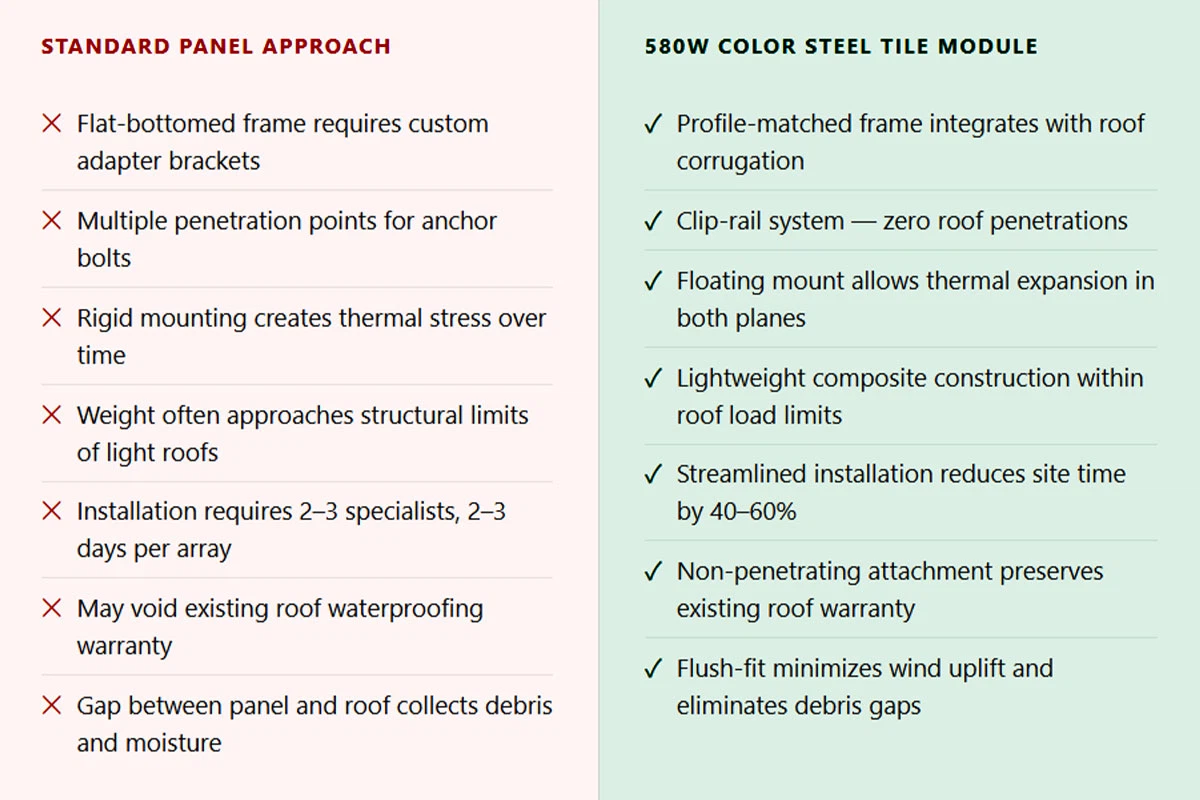
Standard racking clamps damage corrugated profiles, concentrate load at the wrong points, and require modifications the roof wasn't designed for.
Waterproofing Failure Risk
Every penetration through a metal roof is a potential leak. Conventional panel mounting typically requires 8–20 anchor points per panel. Each one is a vulnerability.
Thermal Expansion Mismatch
Metal roofs expand and contract dramatically between night and day. Rigid panel mounts don't. This creates cumulative stress fractures in sealants, fasteners, and sometimes the roof itself.
Weight Load Limits
Light commercial metal roofs are often rated at 10–25 kg/m². Standard glass-glass bifacial panels push against this ceiling, requiring costly structural reinforcement.
Wind Uplift Exposure
Color steel tile roofs - especially on industrial or agricultural buildings - are often in high-wind exposure zones. Undersized mounting systems fail, sometimes catastrophically.
Aesthetic & Warranty Conflicts
Drilling or penetrating a metal roof often voids the roofing manufacturer's waterproofing warranty. That can be a showstopper for building owners.
These aren't rare edge cases. They're the standard landscape anyone faces when trying to put conventional solar on metal roofing. And the downstream consequences - water ingress, structural assessments, re-roofing before solar can proceed - routinely double or triple project costs compared to initial estimates.
"The panel itself worked fine. It was everything around the panel - the mounting, the sealing, the thermal movement - that made the project three times harder than it needed to be."
- Solar installation contractor, Southeast Asia
Why Standard Solar Panels Weren't Designed for This
A conventional monocrystalline or bifacial panel is an excellent piece of engineering - optimized for maximum energy yield per square meter, rigidity, long-term durability. The problem isn't the panel's quality. It's that the panel's form factor assumes a stable, penetrable substrate. Color steel tile roofs are neither.
The corrugated or ribbed profile of a metal roof means panel-to-roof contact is inherently uneven. You're trying to mount a flat, rigid 2m² object on a rippled surface. Standard mounting rails bridge the ribs, which looks workable until you factor in:
- Clamping pressure concentrating on the rib peaks, potentially deforming thinner gauge roofing
- The gap between panel and roof trapping heat, reducing panel efficiency and accelerating UV degradation on sealants
- Wind creating suction loads in those gaps that the mounting clamps weren't rated for
- Condensation accumulating in enclosed air pockets, creating corrosion beneath both the panel and the roof surface
None of this is insurmountable - experienced contractors work around it daily with custom fabrication, careful sealing protocols, and over-engineered mounting. But it's expensive, time-intensive, and introduces variables that any quality assurance program struggles to control consistently at scale.
The majority of solar installation disputes and warranty claims on industrial rooftops trace back not to the panel, but to the interface between a generic panel and an incompatible roof substrate. Matching the product to the surface isn't a minor optimization - it's the single highest-leverage decision in any metal roof solar project.
The 580W Color Steel Tile Solar Module: Built for the Problem, Not Around It
The 580W color steel tile solar module doesn't try to adapt a standard panel to a metal roof. It starts from the roof's constraints and works outward. That difference in design philosophy shows up in ways that matter on an actual job site.
Technical Specifications Worth Understanding
Numbers tell part of the story. Here's where the 580W module stands on the specifications that actually matter for metal roof applications:
|
Specification |
580W Color Steel Tile Module |
|
Peak Power Output |
580W (STC) |
|
Module Efficiency |
21.5–22.3% monocrystalline PERC / TOPCon |
|
Module Weight |
~28 kg - optimized for light commercial roofs |
|
Frame Material |
High-tensile anodized aluminum, matched to roof profile |
|
Mounting System |
Clip-rail, non-penetrating, compatible with standing seam & corrugated profiles |
|
Wind Load Rating |
Up to 2.4 kPa (front) / 2.4 kPa (rear) - suitable for most industrial exposure zones |
|
Snow Load Rating |
5.4 kPa front load |
|
Temperature Coefficient (Pmax) |
-0.34% / °C - low degradation in high-heat metal roof environments |
|
Certifications |
IEC 61215 / IEC 61730 / UL 61730 / CE / MCS |
|
Power Warranty |
30 years linear output guarantee |
|
Roof Compatibility |
Corrugated (C-rib, R-rib), standing seam, snap-lock profiles |
The low temperature coefficient (-0.34%/°C) deserves a moment of attention. Metal roofs get hot - in direct sun, surface temperatures on color steel tile regularly reach 60–80°C in tropical and subtropical climates. Standard panels with a coefficient of -0.45%/°C lose roughly 9–15% of rated output under those conditions. The 580W module's optimized cell technology means real-world yield stays significantly closer to nameplate.
Where This Module Makes the Most Sense
Not every project needs a purpose-built color steel tile solution. But there are clear categories where using anything else makes the project harder than it needs to be.
Large spans of standing-seam metal roofing where speed of installation and structural load limits both matter.
Farm structures with corrugated metal roofs that were never designed for additional structural load from drilling-based mounting.
Where roof warranties, liability, and zero-disruption installation requirements make non-penetrating systems essential.
Retail centers, logistics hubs, and commercial units with metal roofing seeking C&I solar without structural reinforcement costs.
Southeast Asia, Pacific Islands, coastal areas - where wind uplift certification is non-negotiable and conventional mounting fails risk assessment.
When a roof is being replaced anyway, integrated color steel tile + solar modules eliminate redundant work and material costs.
Installation: What It Actually Looks Like
One of the less visible benefits of a purpose-matched panel is what it does to the installation workflow. A job that might require a three-person crew, custom fabrication, and two days of careful sealing work with a conventional setup can often be completed faster with a two-person crew using the clip-rail system.
The process, simplified:
- Survey & design: Roof profile measurement, array layout planning, shading analysis
- Rail installation: Clip-rail system attaches to standing seam or corrugation without drilling - rails are level-adjusted and secured
- Module placement: Panels click into the rail system; no individual fasteners required per module
- Electrical: MC4 connectors, string planning, inverter connection - standard procedure
- Inspection: Clip integrity check, waterproofing visual inspection, torque verification on rail anchors
No roof sealant. No silicone guns. No anxiety about which penetrations you sealed in the right order before it rained. For experienced crews, this is a meaningful quality-of-life improvement. For less experienced teams, it's a significant reduction in the ways things can go wrong.
The most expensive installation mistake isn't buying the wrong panel. It's discovering you bought the wrong panel after you've already planned the project, ordered the hardware, and scheduled the crew.
Frequently Asked Questions
They can, with significant adaptation - custom brackets, careful sealing, and often structural assessment. The result is usually more expensive and more failure-prone than a purpose-built solution. The compatibility problem isn't theoretical; it shows up in insurance claims and roof warranty disputes regularly.
The clip-rail mounting system is compatible with the most common metal roof profiles: corrugated (C-rib and R-rib), standing seam, and snap-lock panels. Profile-specific clip adapters are available for less common rib geometries. It's worth confirming your exact profile before ordering.
Yes. The module outputs standard MC4 connections and is compatible with all major inverter brands and optimizer systems (Enphase, SolarEdge, Huawei, SMA, Growatt, and others). System design follows standard string or module-level optimization principles.
Payback periods vary significantly by region, local electricity tariffs, available incentives, and roof size. In markets with high electricity costs (Western Europe, Australia, Japan, Southeast Asia commercial rates), C&I rooftop solar on metal buildings typically achieves payback in 4–7 years. The reduced installation cost of a purpose-built system versus adapted conventional panels typically shortens payback by 6–18 months.
This varies by manufacturer and distributor. Most factory-direct suppliers accept orders starting at one pallet (typically 20–30 modules) for project testing, with volume pricing kicking in at container-level orders. Contact your regional distributor for current MOQ and logistics options.
Standard solar panel warranties offer 12 years product warranty and 25 years linear power output. The 580W color steel tile module's 30-year linear power guarantee is above industry baseline - a reflection of the TOPCon cell technology's lower degradation rate (typically 0.4%/year vs. 0.55%/year for older PERC designs).

Ready to Spec the Right Panel for Your Project?
Get datasheet, mounting system details, and regional distributor contacts for the 580W color steel tile solar module.
Request a free design proposal→
The Bottom Line
Rooftop solar on metal and color steel tile buildings is one of the highest-potential segments in the commercial solar market. The roof space exists, the energy loads are substantial, and the economics are strong. What's held the segment back isn't appetite - it's a product-market fit problem that conventional panels haven't solved.
The 580W color steel tile solar module isn't a workaround or a compromise. It's what happens when you take the specific constraints of metal roofing seriously from the first line of the design brief. Lighter, profile-matched, non-penetrating, rated for high-wind environments, and backed by a longer power warranty than most alternatives.
If you've been burned by a metal roof solar project that cost more than expected, took longer than planned, or created warranty headaches you're still resolving - the root cause was probably the panel choice. Getting that decision right at the start is simpler than it used to be.
Related topics:
© 2026 Jingsun Solar · Content for informational purposes. Specifications subject to manufacturer updates.