


El Toque & Solar Energy: How Cuban Families Are Escaping Currency Chaos With Solar Systems
Every morning, millions of Cubans open El Toque before they open their fridge. The dollar-to-peso gap tells them what breakfast will really cost today. But there's one household expense that rate can't touch - the solar panels on the roof.
Why do Cubans trust El Toque so much?
If you've spent any time around Cuban families - on the island or in the diaspora - you already know the answer. The official exchange rate and the street rate are two completely different realities. El Toque tracks the informal market rate, which is often the only number that actually reflects what things cost in practice.
It's not about being anti-government or anything like that. It's just survival math. People need to know what their remittances are worth, what their savings can buy, and how far this month's money will stretch. El Toque gives them that honest number.
The real problem runs deeper: Energy costs - electricity and fuel - are one of the heaviest and most unpredictable expenses Cuban families face. Both are dollar-dependent, both are unreliable, and when the power goes out, the losses are immediate. A fridge full of food doesn't wait for the grid to come back on.
The blackouts are the part nobody talks about enough
Over the past few years, Cuba has experienced some of its worst sustained power outages in decades. Some regions have gone 10 to 16 hours a day without electricity. Generators are a workaround - but they run on fuel, and fuel prices move in lockstep with the dollar exchange rate that El Toque is tracking every day.
A lot of families have done the math and realized that what they spend on generator fuel in a single month could go toward a solar kit that pays for itself over a few years. And the sun, unlike the grid, doesn't have a schedule.
8–16h
Daily outage hours in some regions during peak periods
~5 yrs
Typical payback period for entry-level PV kits
2,000+
Annual sunshine hours in Havana - top-tier solar conditions
Entry-level starter kit
3kW
Covers LED lighting, phone charging, a fan, and a small TV. Gets a small household through the night without generator fuel.
Most common starting point
Mid-size family system
5kW
Handles a fridge, a few hours of AC, a washing machine. Solid main power source for a family of 3–5 people.
Best value range
Expanded off-grid system
10kW
Covers nearly all household needs. Add extra battery storage and you're fully supplied through the night.
Long-term investment
Small commercial setup
20kW+
For small restaurants, barber shops, or home-based businesses. Keeps commercial equipment running regardless of outages.
Business use

What does any of this have to do with El Toque?
On the surface, an exchange rate tracker and a solar panel kit seem like totally unrelated things. But they're solving the same problem from two different angles.
El Toque helps Cuban families answer: what is my money actually worth right now? Solar helps them answer: what can I stop spending money on? Both tools are about finding solid ground in an economy that feels like it shifts under your feet every week.
"The exchange rate changes every day. The sun rises every day too - and it doesn't charge in dollars."
When your roof is generating electricity, you've cut out one dollar-denominated expense from your monthly budget. That's not a small thing. Over a year, that's real money that doesn't have to be converted at whatever rate El Toque is showing that morning.
Frequently asked questions
Is it legal to install a solar system in Cuba?
Yes. The Cuban government has opened up policies allowing households to install photovoltaic systems, with particular support for rural areas and communities with chronic power shortages. The exact permitting process varies by municipality, so it's worth checking with local energy offices before installation.
Where do families actually get the equipment?
Most kits currently come through remittance channels - family members abroad purchase equipment in Mexico, Panama, or other nearby countries and arrange shipping or transport into Cuba. Some local resellers exist, but availability and pricing can be inconsistent. The diaspora supply chain is currently the most reliable route.
Is maintenance complicated? Do you need technical skills?
Basic upkeep is genuinely simple - wipe dust off the panels periodically, check battery connections a few times a year. Cuba has also seen a growing number of small local businesses specializing in PV installation and maintenance, so finding someone to help isn't the challenge it used to be.
Does the system work during a blackout?
A battery-backed off-grid system is completely independent of the utility grid - blackouts don't affect you at all. Grid-tied systems without battery storage do go offline when the grid goes down, which defeats the purpose for most Cuban families. Off-grid or hybrid setups with battery storage are the recommended option in this context.
How much does it cost and when does it pay off?
Entry-level 3kW kits typically run $1,000–$3,000 USD depending on brand and how you source them. Given current fuel and backup generator costs for Cuban households, most families see full payback within 4–6 years - after that, the energy is essentially free. Larger systems scale up in cost but often have faster payback due to higher baseline fuel savings.
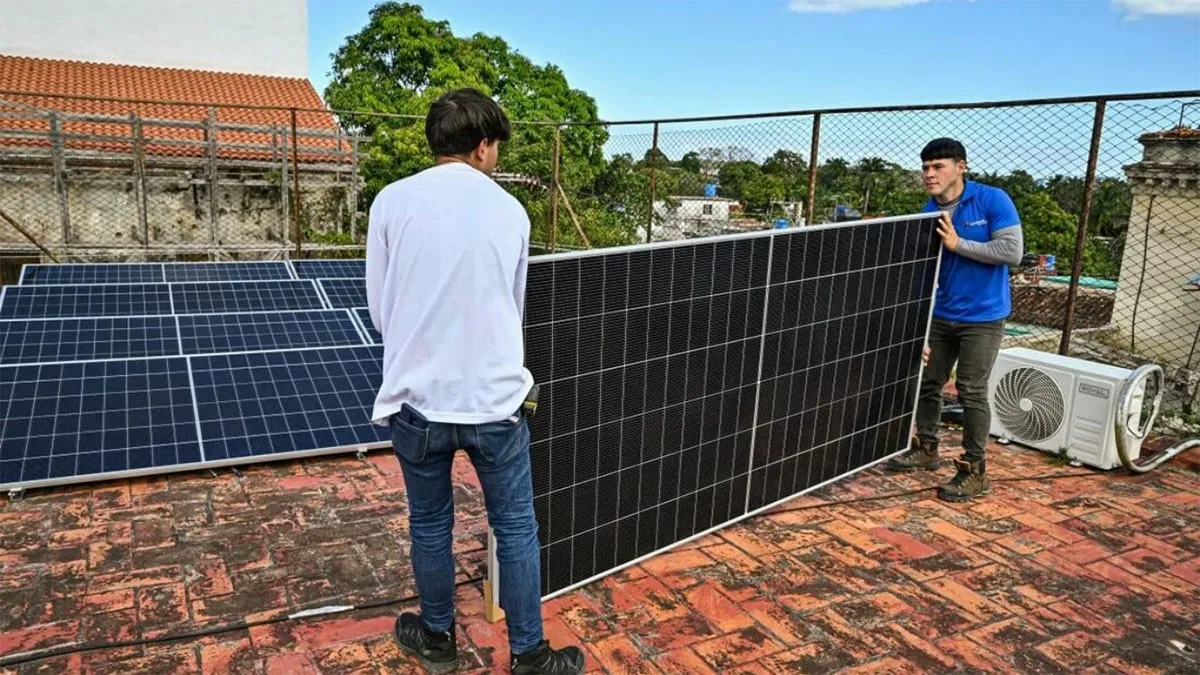
How to choose the right kit for your household?
The most practical starting point is to list the appliances you absolutely cannot live without: fridge, fan, lights, phone chargers. Add up their wattage, multiply by the hours per day you'd use them, and you have a rough daily energy number to shop against.
From there, match that number to a system's output and battery capacity. If there are kids who need to study at night, medical equipment in the home, or a small business to run - go one tier up. It's always better to have a bit more capacity than to run short on a cloudy day.
One thing worth knowing: Cuba's solar conditions are exceptional. Havana, Santiago de Cuba, and most of the island log over 2,000 sunshine hours per year. The same panel that would generate X kilowatt-hours in northern Europe generates 30–40% more in Cuba. Your investment goes further here than almost anywhere else in the world.
Click to get a free design solution
Finding the things the exchange rate can't touch
Cuban families have always been good at finding stability where they can create it - not waiting for it to arrive from the top down. El Toque is part of that. So is growing your own food. So is this.
A solar system on your roof doesn't care what the dollar is trading for today. It doesn't have outages on its schedule. It doesn't require you to convert remittances or find hard currency. It just converts sunlight - which Cuba has in extraordinary abundance - into electricity your family can use.
That's the connection to El Toque. Both tools exist because Cuban families need honest, reliable information and real resources in an unpredictable environment. One tells you what your money is worth. The other helps you need a little less of it.