


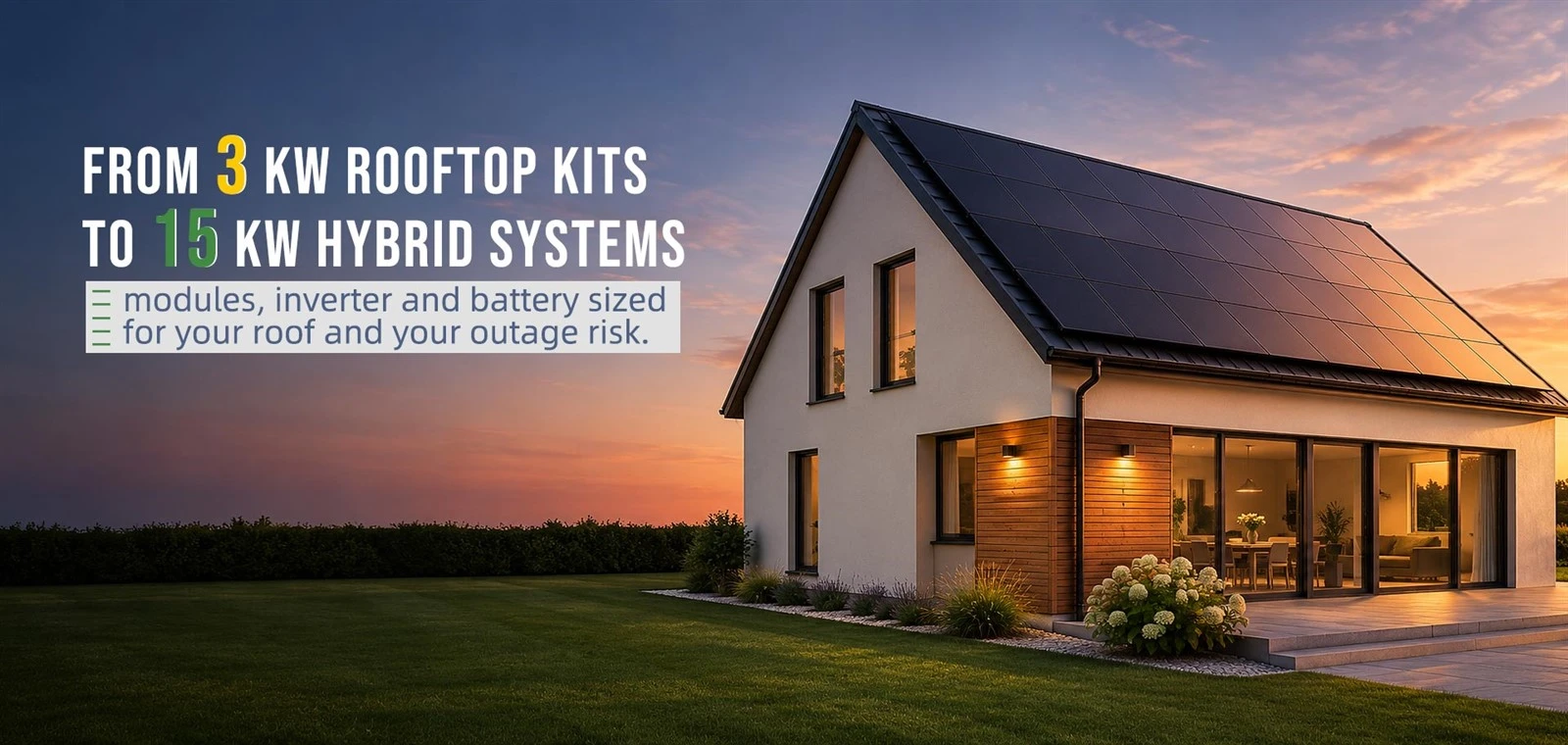
Residential Solar and Battery Storage Solutions
From 3 kW rooftop kits to 15 kW hybrid systems - modules, inverter and battery sized for your roof and your outage risk.
System size
3–15 kW
Battery capacity
5–30 kWh
Certified
CE · IEC · TUV
Who This Is For
A residential solar and battery system is sized from three facts: your usable roof, your daily use, and whether the grid is there when you need it.
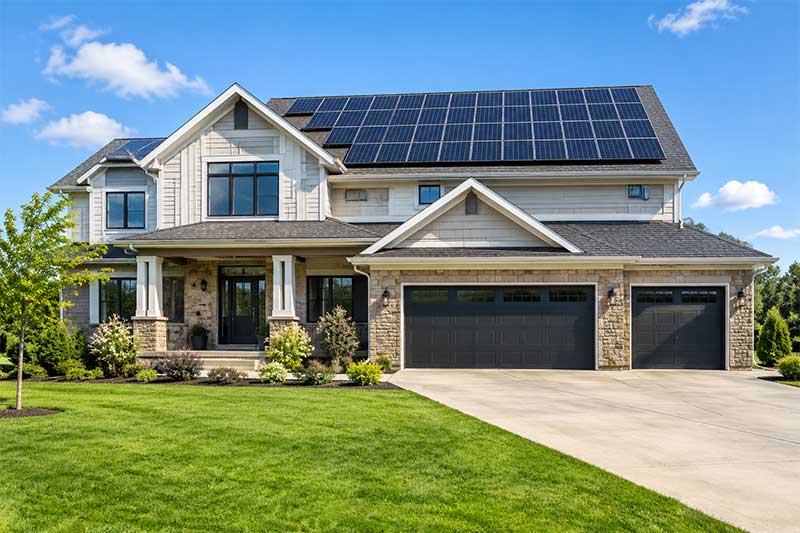
Detached house
- Roof: 30–60 m²
- Daily use: 15–30 kWh
- Grid: connected, but outages are common
- Cares most about: keeping the fridge and air conditioning on when the power drops.
Start with: Standard or High
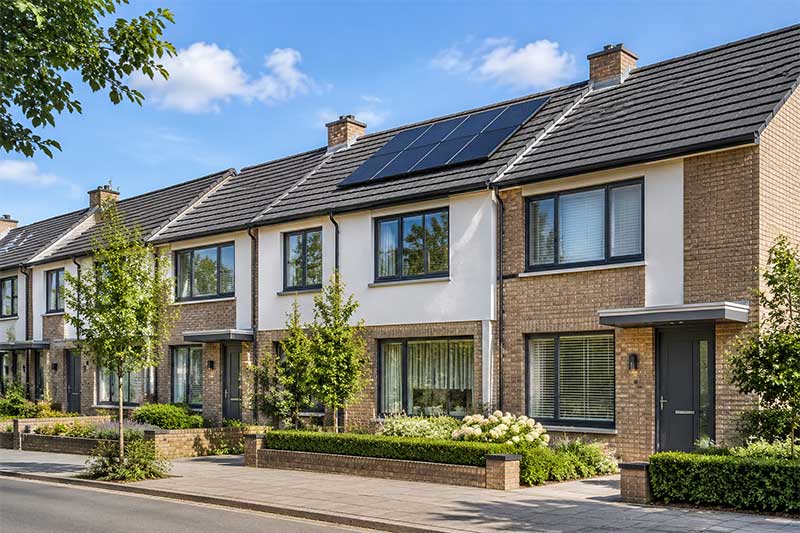
Townhouse or small home
- Roof: 15–30 m²
- Daily use: 8–15 kWh
- Grid: connected
- Cares most about: keeping the upfront cost down and spreading the payment.
Start with: Basic

Off-grid home
- Grid: none
- Daily use: 5–15 kWh
- Cares most about: how many cloudy days the battery can carry.
Start with: the backup sizing below
The Problem
A home with no solar and no storage pays in four ways.
Higher bills
In many markets, retail electricity prices have risen for years, and a household has no say in the next increase.
Outage losses
A fridge that stays off for a day means spoiled food. Some households also run medical equipment, such as oxygen concentrators, that cannot wait for the grid to come back.
Lost work
When the grid goes down, so do the router and the laptop, and with them a day of working from home.
An idle roof
The sun lands on it every day, panels or not, and none of that energy is used.
Together they lead to the two questions this page is built around: how big should the system be, and does it need a battery?
|
|

What the System Includes
What a Residential Solar and Battery System Includes
Five parts make up the system. Your roof decides the first. Your loads and outage risk decide the rest.
|
Part |
What decides its size |
|
Solar modules |
Usable roof area, after shade, vents and edge setbacks |
|
Inverter |
The biggest load you want to run at once, and whether you need backup |
|
Battery |
How long you want the essentials to run when the grid is down |
|
Distribution board |
Which circuits stay on during an outage and which do not |
|
Meter |
Whether you export to the grid, and what your utility requires |
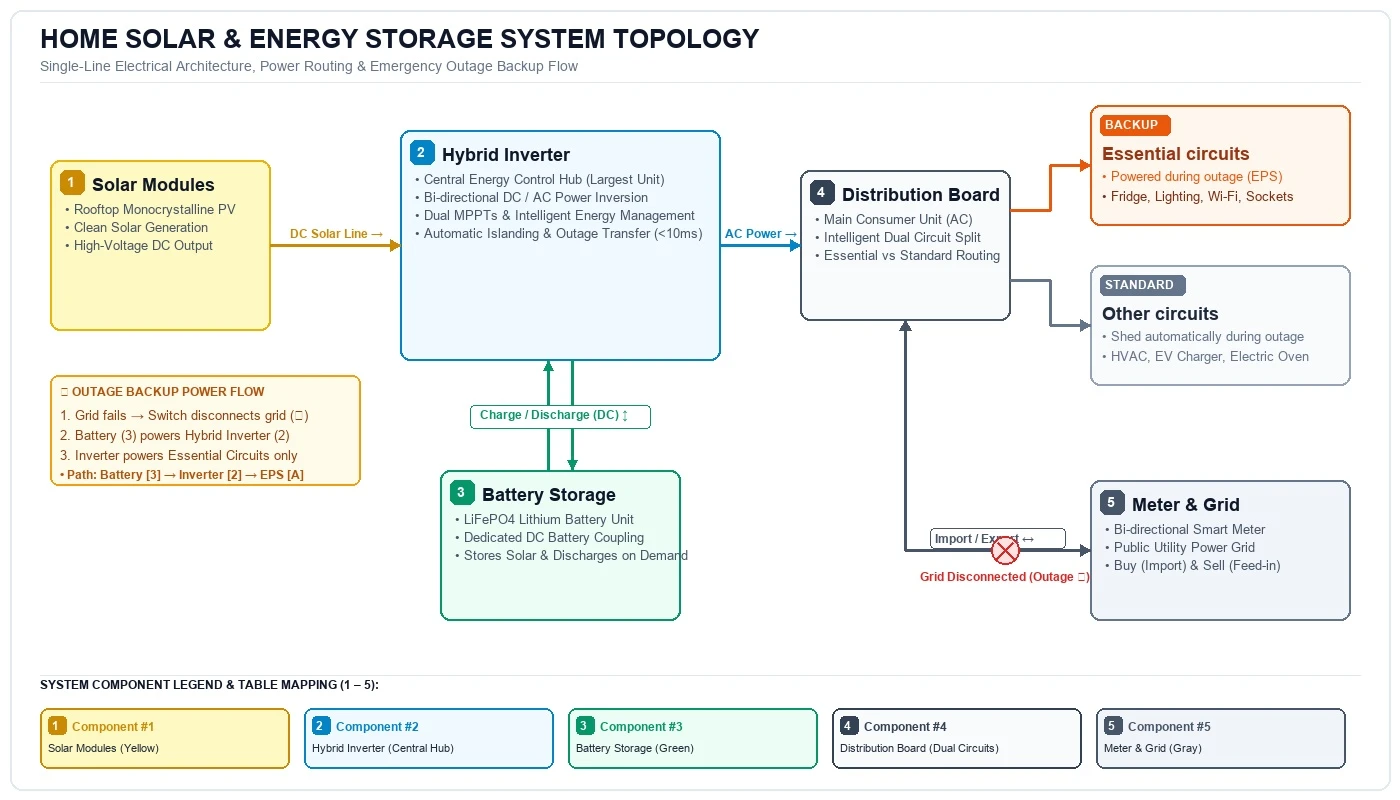
Read it left to right: the roof makes DC power, the inverter turns it into AC for the house, and the battery stores the surplus. When the grid drops, the inverter isolates the house and runs the essential circuits from the battery.
Solar Modules: Why More Watts Is Not Always Better
Start from the roof. Measure the area free of shade, vents and edge setbacks, then fit modules into it. A higher rating only helps if the panels fit.
We offer 750 W, 800 W and 850 W modules. To count them, divide the system size in kW by the module rating in kW: a 10 kW target with 850 W modules is 12 panels, or 10.2 kW. Then check the panel dimensions against your roof.
[Which rating suits which roof size and mounting method].
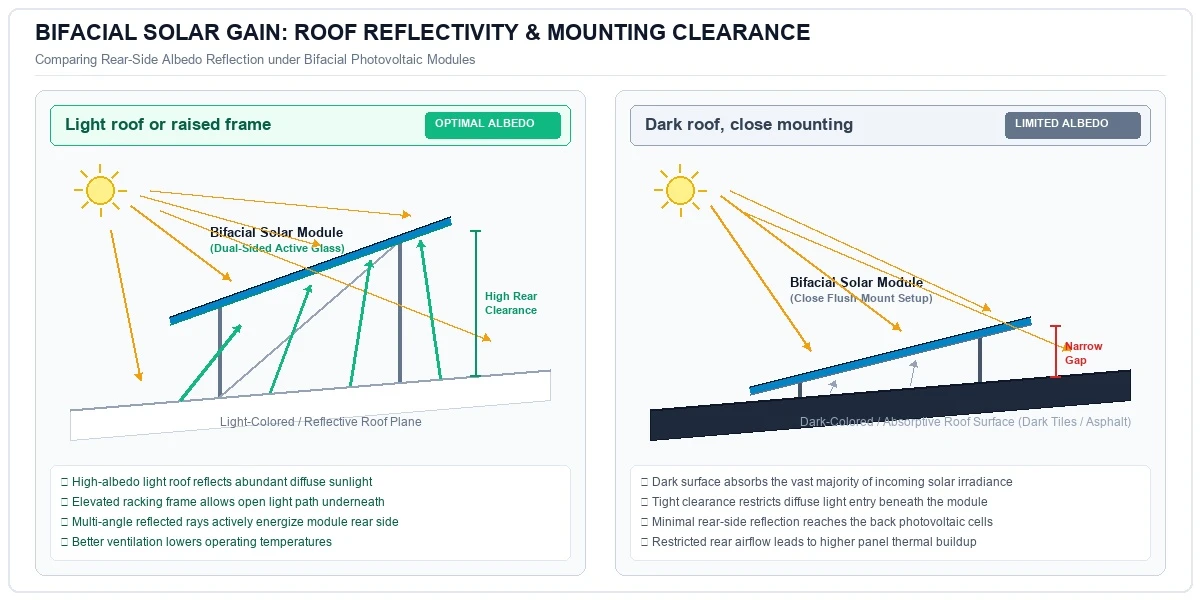
Bifacial gain depends on your roof
Bifacial modules also collect light on the back. Over a light roof, or on a raised frame where light bounces underneath, the rear side adds real output. Over a dark roof with panels close to the surface, there is little reflected light and the gain is small. In that case, ask us to calculate without bifacial gain.
Battery Types: Rack, Stacked or Wall-Mounted
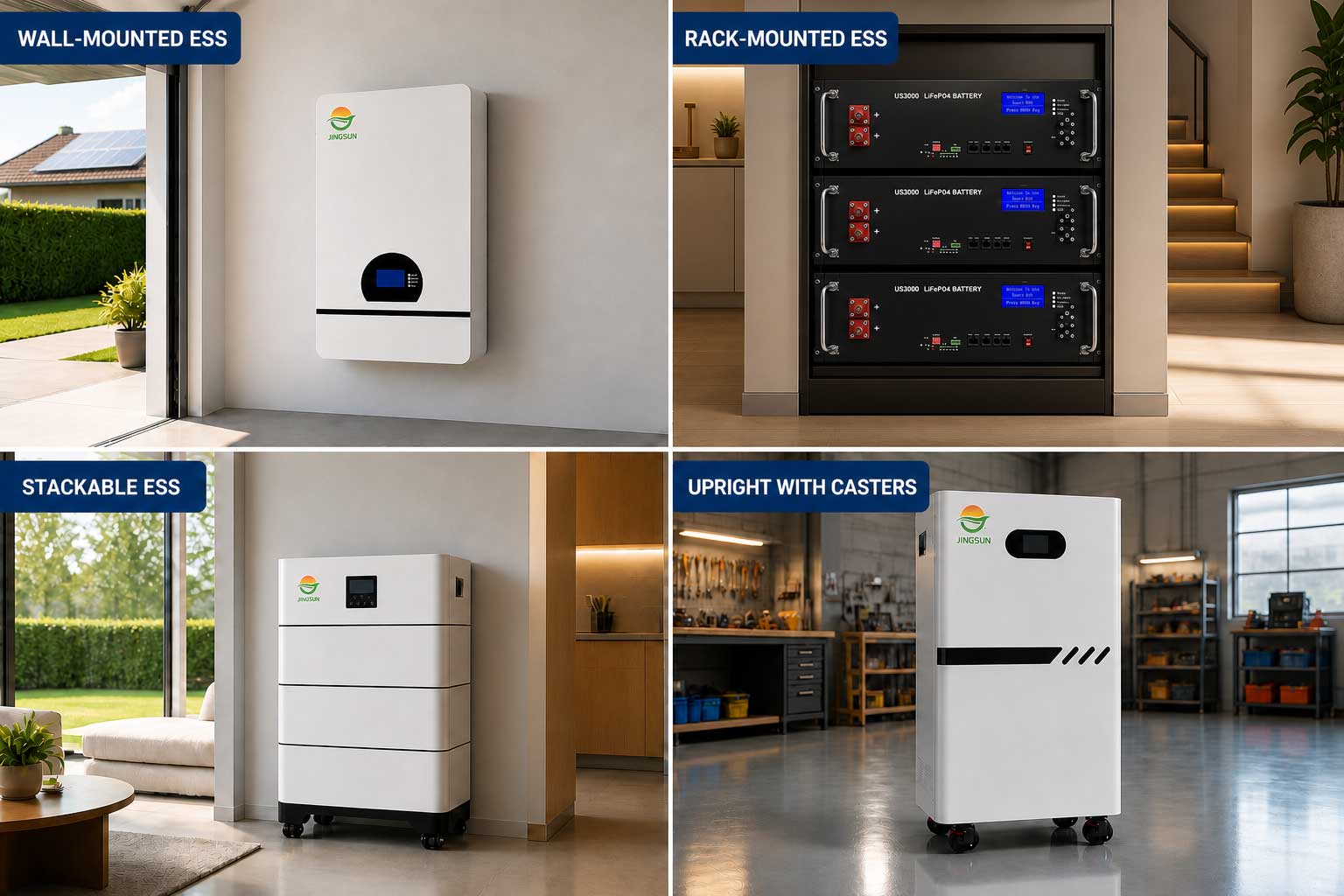
Battery shape decides where it can go and how you expand later. The wrong choice is the usual reason a home cannot grow.
|
Type |
Where it goes |
How you expand |
Best for |
|
Rack |
Indoor equipment room or garage |
Add modules. The most flexible option. |
A dedicated space and plans to grow |
|
Stacked |
Indoors, floor-standing against a wall |
Add layers one by one |
Saving floor space, caring about looks |
|
Wall-mounted |
On a wall |
Each unit is fixed in size; expanding means adding another unit |
Small homes with little space |
|
UPRIGHT WITH CASTERS |
Non-fixed installation |
Each unit is fixed in size; expanding means adding another unit |
For use in workshops or office areas where frequent relocation is required. |
See our lithium battery range →
Three Standard Configurations
Pick the row that matches your daily use. Near a boundary? Ask us first.
|
Tier |
Modules |
Inverter |
Battery |
Choose it if |
|
Basic |
3–5 kW |
5 kW hybrid |
5 kWh |
Daily use is up to 15 kWh and the goal is a lower bill |
|
Standard |
8–10 kW |
10 kW hybrid |
10–15 kWh |
Daily use is 15–20 kWh and you want the essentials kept on in an outage |
|
High |
12–15 kW |
15 kW hybrid |
20–30 kWh |
Daily use is above 20 kWh |
Above 20 kWh a day, go straight to High. For backup beyond day one, or an off-grid home, size the battery from the outage section below and take the tier that covers it.
Free Consultation: Complete Guide →
Grid-Tied, Hybrid or Off-Grid
Hybrid vs Off-Grid Home Solar: Which Connection Do You Need?
When grid-tied is enough
Your grid is stable and the goal is a lower bill. Panels and an inverter, no battery. It costs least, and it shuts down when the grid does.
When to add a battery (hybrid)
You want power during outages. A battery and a hybrid inverter let the house keep running when the grid is off.
When there is no grid (off-grid)
Everything you use comes from panels and battery, so the battery is sized for cloudy days, not only for the evening.
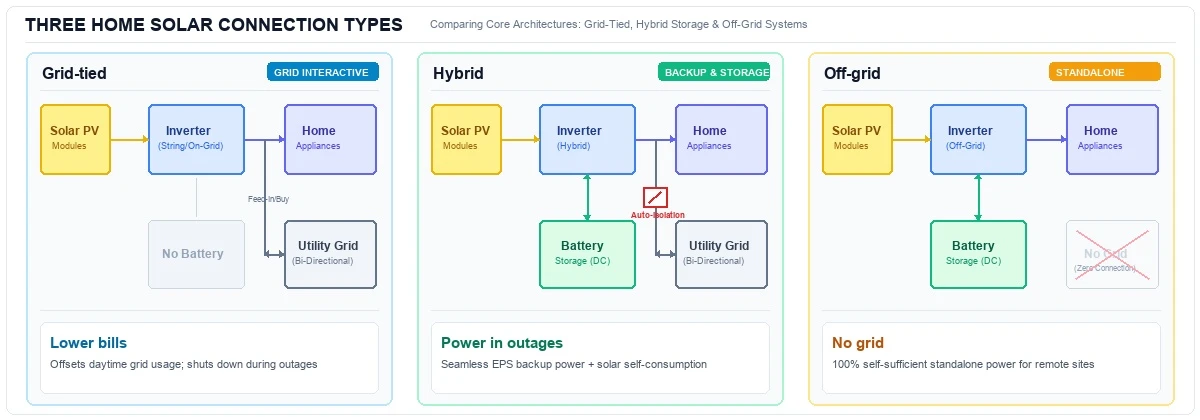
We don't recommend hybrid to everyone. It typically costs 15–30% more than grid-tied. With a reliable grid and nothing that must stay powered, choose grid-tied. If outages are more than a nuisance, the extra cost is worth it. See our hybrid and grid-tied inverters.
What Drives the Payback
Net Metering and Home Solar Payback: What Drives the Numbers
We don't quote one payback period. It depends on four things that change by country and household:
Local electricity price
It sets what each kWh you stop buying is worth.
Self-consumption
The share of your solar output that you use yourself. A battery raises it.
Net metering rules
What you are paid or credited for exported power. Some countries credit the retail price, some a lower rate, some nothing.
Subsidies
Where they exist, they lower the purchase cost. Rules change often, so we don't list them here.
A formula you can use
|
Yearly generation (kWh) = system size (kW) × peak sun hours per day × 365 × 0.75–0.85 Yearly saving = generation × self-consumption share × your tariff + exported kWh × your export rate Simple payback (years) = system cost ÷ yearly saving |
Illustration, not a quote: 8 kW, 4 sun hours and 0.8 efficiency give 9,344 kWh a year. At 60% self-use, 0.20 per kWh and 0.05 for exports, the saving is about 1,308 a year.
What You Can Run During an Outage
Solar Battery Backup Sizing: What Runs During an Outage
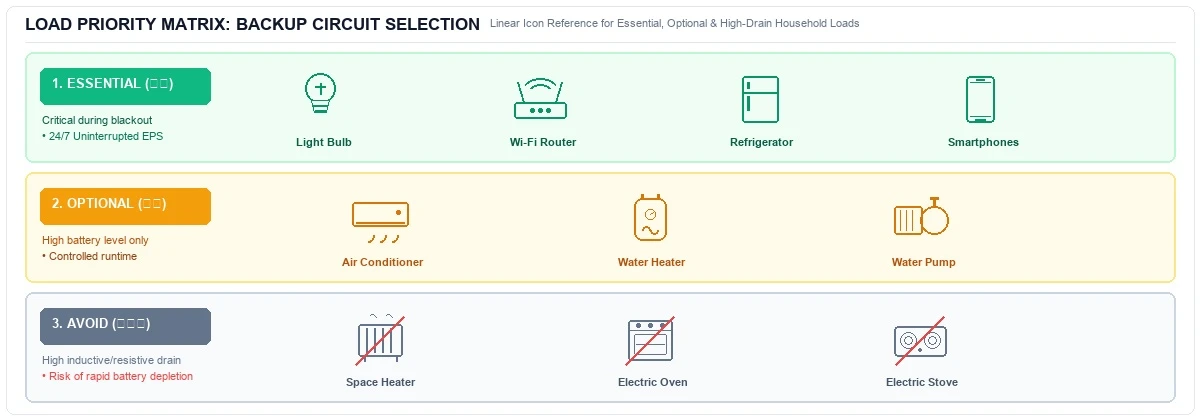
Sort your loads into three groups, then size the battery for the first two.
|
Priority |
Loads |
What to know |
|
Must keep |
Lighting, router, fridge, phone charging |
The core of the first 24 hours. Low draw, so they come first. |
|
Optional |
Air conditioner, water heater, water pump |
Depends on battery capacity and inverter power. We calculate each one separately. |
|
Not advised |
Electric heating, oven, high-power hot plates |
They drain a battery fast. Better to know that before the first outage. |
From load list to battery size
Usable energy needed (kWh) = average load (kW) × backup hours. Lighting, router, fridge and chargers average around 0.3 kW, so 24 hours takes about 7 kWh. A battery in the 10–15 kWh range covers that with room to spare. Use the usable capacity from the datasheet, not the headline figure.
Certification and Grid Compliance
CE, IEC and TUV cover the equipment. Your grid connection is approved separately by the local utility.
|
What we provide |
What you or your installer handle |
|
Document set: CE declaration, IEC test reports, TUV certificates, datasheets, manuals |
The connection application to your utility |
|
Technical documents the utility asks for with the application
|
Any installer licence or permit your country requires |
|
A meter change, if the utility requires one |
Tell us your country with your quote request and we will check our documents against your utility's requirements.

How We Deliver
|
Step |
What you get |
|
Design support |
A configuration sized from your roof, daily use and outage needs, sent with the quote. |
|
Certificates |
The equipment document set described above, sent with the order. |
|
Shipping |
Packed and shipped from our factory. [Shipping terms, e.g. FOB / CIF / DAP] |
|
Installation guidance |
Manuals and wiring diagrams, with [remote support] for your installer during commissioning. |
|
Warranty |
Solar Modules: Up to 15-Year Product Warranty + 30-Year Linear Power Warranty Energy Storage Batteries: Up to 10-Year Product Warranty |

FAQ
Q: How many cloudy days can the battery cover?
A: On essentials alone, about 7 kWh a day, a 10 kWh battery lasts roughly a day and a half with no sun, 15 kWh about two days, 30 kWh about four.
Q: Do I need a new meter?
A: It depends on the utility. If you export power, you usually need a meter that records both directions, and the utility fits or approves it. Ask when you file the connection application.
Q: Can my roof carry the panels?
A: Most arrays add roughly 12–20 kg per square metre with mounting. Send us the roof material, age, rafter spacing and local snow and wind loads. Local code may require an engineer's sign-off.
Q: Can I add capacity later?
A: It depends on the battery type. Rack batteries take extra modules, stacked ones take extra layers, wall-mounted ones need another unit. The inverter's battery limit applies either way, so check it first.
Q: Should the battery go indoors or outdoors?
A: Three things decide: the datasheet's temperature range, the ingress protection rating, and fire clearances under local code. Avoid freezing rooms and direct heat, and follow the manual.
Q: How long does the grid connection take?
A: Typically a few weeks to a few months, depending on the utility. You or your installer submit the application, and we supply the technical documents.