



Why Are Tech Giants on a Solar Power Buying Spree?
The numbers say it all: four companies. Half the world's clean energy deals
In February 2026, BloombergNEF released a report that sent shockwaves through the energy industry: in 2025, Meta, Amazon, Google, and Microsoft together signed 49% of all corporate clean energy power purchase agreements (PPAs) globally.
Not 49% of the tech sector. 49% of every company, in every industry, across the entire world.
Total corporate PPA volumes reached 55.9 GW that year. Even as overall deal volumes declined for the first time in nearly a decade, these four companies didn't slow down. Meta and Amazon alone contracted a combined 20.4 GW - with solar firmly at the center of it all.
So what's driving this? Why are the world's most powerful tech companies racing to lock in solar electricity?
The root cause: AI is devouring electricity at an unprecedented rate
The story starts with artificial intelligence.
Training a large AI model requires data centers running at full capacity for weeks on end. A single hyperscale data center can consume more electricity than a mid-sized city. In 2025, global investment in AI data center infrastructure reached an estimated $580 billion - and the corresponding surge in electricity demand is outpacing what most power grids can handle.
According to the International Energy Agency (IEA), global data center electricity consumption is projected to climb from 460 TWh in 2024 to over 1,000 TWh by 2030 - more than doubling in six years. Renewables are set to meet nearly half of that additional demand, making them the fastest-growing electricity source for data centers, expanding at an average annual rate of 22%.
The pressure doesn't stop there. In some U.S. regions, rapid data center expansion is already pushing up household electricity bills. Power grids are straining. New energy sources need to come online fast.
Why solar, and not something else?
Tech companies have options: natural gas, nuclear, wind, geothermal. Yet solar remains the number one generating technology for corporate PPAs. The reasons aren't complicated.
First: cost.
Between 2010 and 2024, the levelized cost of energy (LCOE) for utility-scale solar fell by 90%, reaching $0.043/kWh - already 41% cheaper than fossil fuel generation on average. In China and India, costs are even lower, at $0.033 and $0.038/kWh respectively. Signing a long-term solar PPA is essentially locking in a highly competitive electricity price for the next ten to twenty years.
Second: speed.
Solar projects can be developed and built far faster than nuclear or hydro. When AI-driven electricity demand is growing quarter by quarter, the energy that can be delivered quickly is the energy that matters.
Third: commitments are on the line.
Every one of these companies has made public net-zero or carbon-free energy pledges. Google aims to run on 24/7 carbon-free energy by 2030. Microsoft has committed to being carbon-negative by 2030. Meta and Amazon have equally aggressive clean energy roadmaps. Against those commitments, procuring solar isn't an option - it's a requirement.
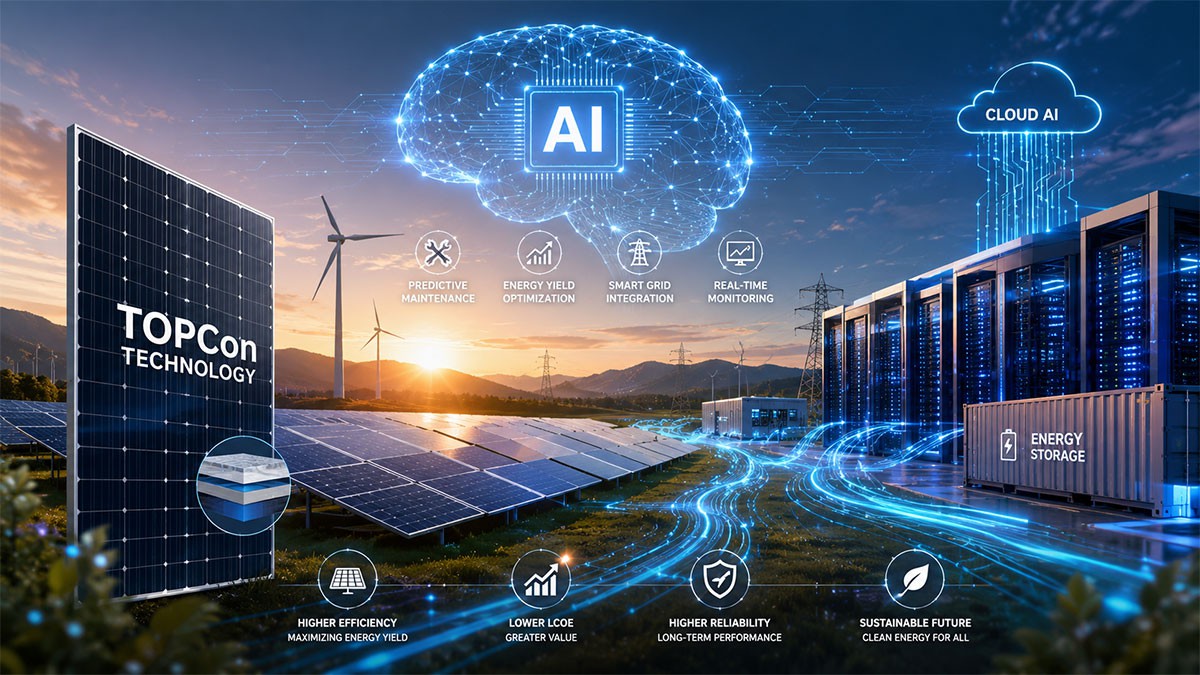
What are they actually buying?
Here's what the publicly disclosed deals look like:
Meta was one of the world's largest solar buyers in 2025, signing over 8 GW of solar PPAs concentrated in the U.S. market. Deals included a 2.5 GW multi-project agreement with NextEra Energy and a 200 MW solar PPA with RWE in Texas.
Amazon deployed the most geographically diverse procurement strategy of any buyer, with active deals across Europe and Asia Pacific - including a 472 MW onshore wind PPA with OX2 in Sweden, a series of PPAs totaling 476 MW with Iberdrola in Spain, and approximately 4 GW of solar projects across multiple markets.
Google signed a series of PPAs with Clearway Energy covering data centers in Missouri, Texas, and West Virginia, representing over $2.4 billion in energy infrastructure investment. Google is also pushing toward hybrid "firm power" solutions to meet its round-the-clock clean energy goals.
Microsoft had already built a contracted renewable energy portfolio of 34 GW across 24 countries by 2024, with solar as a core pillar of that mix.
A new standard: solar + storage is becoming the default
Standalone solar has one obvious vulnerability - when the sun goes down, generation stops. Data centers need uninterrupted power around the clock.
This is exactly where the market is shifting.
In 2025, BloombergNEF tracked nearly 6 GW of "hybrid" clean energy contracts - solar paired with battery storage, wind-solar combinations, or nuclear baseload complemented by solar. Seven of the top ten clean energy sellers that year were offering these "baseload-like" products.
Solar-plus-storage is evolving from a premium add-on to a baseline expectation. For solar procurement professionals, this signals a clear direction: storage is no longer optional in project design - it belongs at the core of any serious proposal.
What this means for global solar procurement
This procurement wave, driven by the world's biggest tech companies, is reshaping market dynamics across the board.
Buyer concentration is rising. Hyperscalers are increasingly dominating the global PPA market. They sign larger deals, accept more complex structures, and commit to longer contract terms. For solar developers and equipment suppliers, entering these supply chains means both scale and long-term stability.
The geographic center of gravity remains in the Americas and Europe. North America accounted for 32.1 GW in 2025, with the U.S. alone at 29.5 GW. Europe, the Middle East, and Africa combined for 17 GW. Asia Pacific softened overall, though Japan hit a record 1.1 GW and Malaysia is gradually maturing as a market.
Technical expectations are rising. Tech companies aren't just buying electricity - they're buying reliable clean electricity. This places greater demands on module performance consistency, long-term project O&M, and the quality of integrated storage solutions.
The demand pipeline is enormous. The IEA projects that data centers alone will require the equivalent of roughly 85 GW of additional solar capacity by 2030, compared to 2025 levels. That figure doesn't include the energy transition needs of every other industry.
Final thought
For most of solar's history, large-scale adoption was driven by government subsidies and policy mandates. A new force is now taking over: pure commercial logic.
Tech giants are not buying solar because regulators told them to. They're buying it because it is the most practical way to power an AI arms race, honor carbon commitments, and control long-term energy costs - all at once.
When the world's most profitable companies start placing billion-dollar bets on solar's future, the market has already delivered its verdict.
At Jingsun, we work with solar procurement teams across the globe to navigate this rapidly evolving market - from module selection and project sourcing to long-term supply chain partnerships. If you're looking to scale your solar procurement strategy, get in touch with our team.
Sources
BloombergNEF, 1H 2026 Corporate Energy Market Outlook (February 2026) Global corporate PPA volumes for 2025, tech giant market share, and regional breakdowns.
International Energy Agency (IEA), Energy and AI Report (2025) Data center electricity demand forecasts through 2030; renewables growth rate and share projections.
ESG Today, "Amazon, Meta, Google, Microsoft Account for Half of Global Clean Energy Purchase Deals in 2025" (February 2026) PPA deal specifics, market divergence between hyperscalers and smaller buyers.
Data Center Dynamics, "Big tech firms account for 49% of corporate clean energy deals over 2025" (2026) Meta and Amazon deal breakdowns, including NextEra, RWE, OX2, and Iberdrola contracts.
PV Magazine, "Corporate PPA deals down 10% in 2025 as AI demand plugs gaps" (February 2026) Global cPPA market overview; solar as the leading generation technology in corporate clean energy deals.
InfoLink Consulting, "AI Data Centers' Surging Power Demand: A Catalyst for Solar-Plus-Storage Integration" (March 2026) Quantified analysis of data center-driven solar demand; 85 GW incremental capacity projection.
Zhihu / Global and China PV Industry In-Depth Analysis Report (2024–2030) Historical LCOE decline data (90% reduction); per-market cost benchmarks. ESG Dive, "Google inks PPAs to power data centers with carbon-free energy" (January 2026) Google–Clearway Energy PPA project details and $2.4B investment figure.
Carbon Credits, "Meta, Amazon, Google, and Microsoft Dominate Clean Energy Deals" (February 2026) Hybrid clean power contract trends; 6 GW hybrid agreement data.