


Organized crime, weak enforcement, and a thriving black market have made solar theft one of South Africa's fastest-growing property crimes. Here's how to protect your system - from hardware to legal frameworks.
Solar panel theft across South Africa has escalated from opportunistic break-ins to coordinated, gang-operated operations targeting residential properties, farms, schools, and large-scale commercial installations alike. High-value components - lithium batteries, inverters, and panels - are stripped and funneled through informal markets within hours of a theft. Addressing this requires action on seven fronts simultaneously.
Five core factors driving the crisis: organized gang activity with clear division of labor; a frictionless black market for secondhand solar equipment; widely poor physical security on installations; rising theft during transport and in warehouses; and persistently low conviction rates across high-risk provinces including Gauteng, Limpopo, and Eastern Cape.
1. Physical Hardware Security
The most immediate line of defense is making your equipment physically hard to steal. Most installations in South Africa remain dangerously easy to dismantle with standard tools in under ten minutes.
Anti-Theft Fasteners & Enclosures
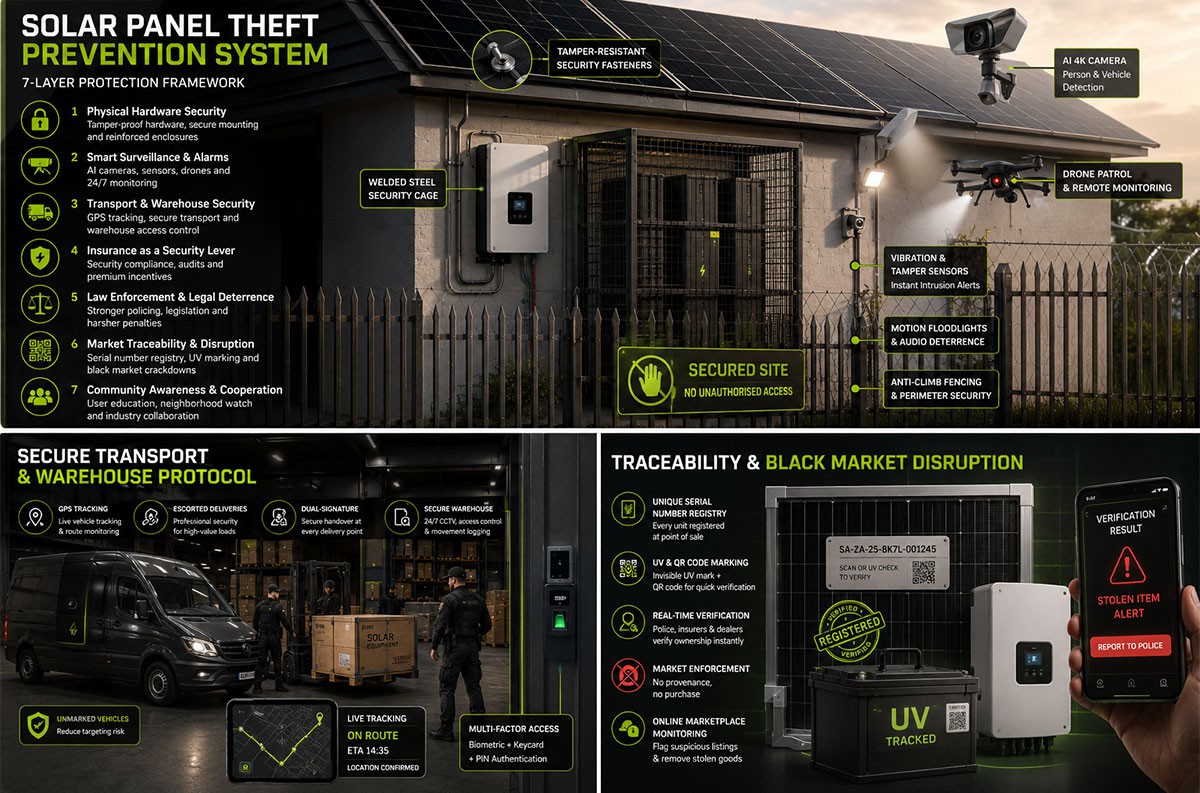
Replace all standard bolts with tamper-resistant security bolts and anti-removal nuts that cannot be undone with off-the-shelf tools.
Enclose lithium batteries and inverters in welded steel security cages - these are your highest-value, most-targeted components.
Apply UV-resistant anti-theft marking paint or etching to panels to reduce resale value and aid identification.
Site Perimeter & Access Control
Install anti-climb barriers, palisade fencing, or razor wire around farms, rural homes, and outdoor solar arrays.
Add physical isolation netting around public installations (schools, clinics) with clearly visible no-access signage.
Mark ground perimeters around sensitive equipment to assist camera-based intrusion detection.
Embedded Installation Design
Wherever possible, use flush-mount or structurally integrated panel designs that cannot be quickly unbolted and carried away.
Factor anti-theft design into the installation quote from day one - retrofitting is expensive and rarely as effective.
2. Smart Surveillance & Alarm Systems
Technology closes the gaps that physical barriers leave open, especially across large or remote sites where round-the-clock human guarding is impractical.
Camera Infrastructure
Upgrade to 4K IP cameras with AI-powered motion analysis capable of person detection, vehicle recognition, and anomaly alerts.
House cameras in vandal-resistant, tamper-proof enclosures - thieves routinely destroy or spray-paint cameras before a job.
Offsite cloud backup all footage automatically so that local storage theft or destruction doesn't erase the evidence trail.
Drone & Remote Patrol
Deploy scheduled drone patrols over large farms and commercial installations, especially after dark and during weekends.
Integrate drone feeds with AI image recognition to auto-flag unfamiliar vehicles or suspicious movement patterns.
Alarm Triggering & Response
Install vibration sensors and tamper alarms directly on panels, cages, and mounting structures that trigger the instant any component is disturbed.
Link alarms to a 24/7 armed response service with a guaranteed response time - a siren alone is rarely enough.
Add motion-activated floodlighting in combination with audio alerts for compounding deterrent effect at night.
3. Transport & Warehouse Security
A significant proportion of solar equipment is stolen in transit or from warehouses - not from final installations. Suppliers and installers must treat the supply chain as a critical vulnerability.
Transport Protocol
Use unmarked vehicles for solar goods deliveries - branded or labeled trucks are pre-selected targets.
Fit all delivery vehicles with live GPS tracking; alert the dispatch team immediately if a vehicle deviates from its route.
Assign professional security escorts for high-value shipments exceeding threshold values.
Require dual-signature handover at every delivery point - no single-party acceptance for equipment above a set value.
Warehouse Controls
Implement multi-factor access control (key card + biometric) at warehouse entry points.
Maintain 24/7 on-site security personnel with full CCTV coverage including loading bays and blind spots.
Log every stock movement with timestamped records - discrepancies should trigger an immediate internal review.
Increase patrol frequency during high-risk windows: public holidays, late nights, and weekends.
4. Insurance as a Security Lever
The insurance industry can drive adoption of security standards far faster than government mandates alone. Structuring policies correctly creates powerful financial incentives for property owners to invest in genuine protection.
Policy & Underwriting Standards
Insurers should require anti-theft compliance certification as a precondition for coverage - non-compliant installations face rejection or premium loading of 20–30%.
Commission independent security audits of insured assets and tie premium rates to audit outcomes.
Offer tiered premium discounts for higher-rated security setups - the better the protection, the lower the premium.
Claims Policy Design
Reduce or deny payouts where theft resulted from demonstrable failure to maintain basic security standards.
Fast-track claims for policyholders who provide video evidence, serial number records, and police case numbers.
Apply an escalating deductible for repeat claims attributed to the same unresolved security gap.
5. Law Enforcement & Legal Deterrence
Enforcement gaps are the root cause of South Africa's solar theft crisis. Low arrest and conviction rates signal low risk to criminal networks. This must change through targeted deployment and legal reform.
Targeted Policing
Increase visible patrol density in documented high-frequency zones across Gauteng, Limpopo, and Eastern Cape - rural roads, informal areas, and farm perimeters.
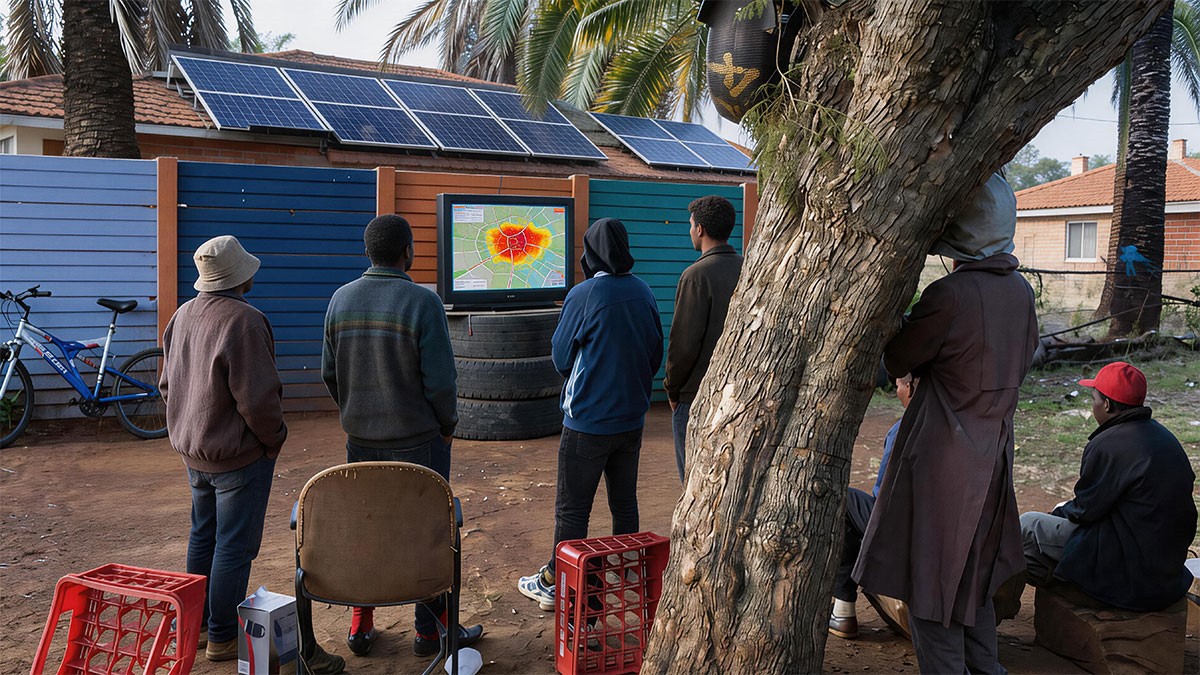
Establish a dedicated solar infrastructure crime analysis unit to produce rolling hotspot maps and shift resources dynamically.
Target late-night unmarked vehicles and known fencing routes for proactive interception.
Legislative Reform
Classify solar infrastructure under critical infrastructure protection legislation, enabling stiffer sentencing.
Apply organized crime statutes to gang-operated solar theft rings - treat it as a serious syndicated offense, not a property crime.
Create a national offender registry for solar and energy infrastructure theft, shared with insurers and employers.
Cross-Border Coordination
Formalize intelligence sharing with neighboring states to disrupt cross-border theft syndicates.
Strengthen controls on non-resident transient labor linked to organized theft operations.
6. Market Traceability & Black Market Disruption
Stolen solar equipment is valuable precisely because it's easily resold. Making panels traceable and cracking down on informal secondhand markets removes the profit motive.
National Serial Number Registry
Implement a mandatory industry-wide equipment registry - every panel, inverter, and battery unit receives a unique code recorded at point of sale.
Police and insurers get real-time query access to verify ownership and flag stolen items during secondhand sales or site inspections.
Apply invisible UV fluorescent tracking marks on equipment surfaces, detectable only with specialist scanners - these survive cleaning and repainting attempts.
Secondary Market Enforcement
Require all secondhand solar dealers to verify and record provenance for every unit purchased - no paperwork, no purchase.
Conduct regular enforcement sweeps of informal markets and scrapyards known to traffic solar components.
Partner with online marketplaces (OLX, Facebook Marketplace) to flag and investigate solar listings without provenance documentation.
7. Community Awareness & Industry Cooperation
The final layer of protection is human. Educated property owners make better decisions; connected communities deter crime collectively.
User Security Habits
Set up remote monitoring alerts on your phone - theft frequently happens during working hours when owners are away, or between midnight and 4 am.
Distribute multilingual security guides (English, Zulu, Xhosa, Afrikaans) covering installation best practices, alarm protocols, and insurance requirements.
Encourage property owners to form WhatsApp or Signal neighborhood watch groups for rapid local incident sharing.
Professional Installation Standards
Work only with installers who include security planning as a standard component of the installation specification - not an add-on.
Push the industry association to develop and enforce a minimum anti-theft installation standard, embedded in inspection and sign-off checklists.
Sector-Wide Intelligence Sharing
Build a shared incident data platform between solar companies, security firms, and law enforcement for real-time theft hotspot visibility.
Hold quarterly cross-sector security briefings to review new theft patterns, update countermeasures, and coordinate responses at scale.
Implementation Roadmap
Not every measure can be deployed at once. Prioritize actions by urgency and impact:
| Phase | Timeline | Key Actions | Expected Outcome |
|---|---|---|---|
| Immediate | 0 – 3 months | Hardware upgrades, camera replacement, alarm installation, transport protocol | Rapid reduction in theft probability; immediate deterrent effect |
| Mid-Term | 3 – 12 months | Insurance policy reform, black market crackdowns, warehouse controls, community watch programs | Market-side disruption; financial pressure on owners to comply |
| Long-Term | 1 – 3 years | National serial number registry, legislative reform, industry intelligence platform | Systemic reduction in organized crime; viable prosecution pipeline |
The Bottom Line
Solar panel theft in South Africa is not an isolated property crime - it is a syndicated, market-driven problem that requires a multi-layered response. No single measure is sufficient on its own.
In the short term, hardware hardening and smart surveillance reduce individual exposure. In the medium term, insurance incentives and market enforcement cut off the profit motive. In the long term, traceability systems and legislative reform make organized solar theft structurally unviable.
Owners, installers, insurers, law enforcement, and government must act in concert. The technology exists. The legal mechanisms can be created. What's required now is coordinated will.