



Sourcing Solar (PV) Products from China to Cuba: A Full-Chain Operations Guide
Why This Is a Window of Opportunity for Cuba's Solar Market
Cuba has long relied on oil-fired power generation. Since 2024, the country has experienced repeated nationwide blackouts, compounded by an ongoing U.S. oil embargo that has tightened further. In response, the Cuban government has made solar power a central pillar of its energy self-rescue strategy. Between 2025 and 2026, Cuba's solar installed capacity has expanded at an unusually fast pace - dozens of solar parks have been completed nationwide, and solar's share of power generation has risen quickly from under 3% to roughly 10%. The government's stated plan is to complete 92 solar parks with more than 2 GW of total installed capacity by 2028.
At the same time, China has become Cuba's leading supplier of solar equipment. According to data compiled by the energy think tank Ember, the value of Chinese solar panel exports to Cuba jumped from roughly USD 3 million in 2023 to approximately USD 117 million in 2025 - an increase of more than 1,800%.
More importantly, between 2025 and 2026 Cuba introduced a series of policies that are highly favorable to distributors:
Resolution 169/2025: For the first time, this resolution extended import duty exemptions to "legal entities" broadly - covering state enterprises, private micro, small, and medium enterprises (MIPYMEs), and mixed-ownership companies - rather than limiting the benefit to state enterprises and ministerially-approved foreign joint ventures, as had previously been the case.
Resolution 41/2026 (February 2026): This resolution eliminated customs duties entirely on the import of solar panels, batteries, inverters, and associated equipment. Individuals and legal entities - including private businesses - whose projects are capable of feeding electricity into the national grid and have obtained technical approval from Cuba's National Renewable Energy Office (ONURE) are eligible for up to eight years of income tax exemption.
In short: as long as the intended use of the equipment is clear and the documentation is complete, compliant private distributors (MIPYMEs) can now legally access duty-free treatment - a policy window that did not exist a few years ago.
The Reality You Cannot Ignore: Cuba Is Under U.S. Sanctions, and Compliance Is the First Hurdle
Before getting into operational details, it's important to be clear about what makes this business uniquely challenging: Cuba remains on the U.S. Treasury's OFAC sanctions list and has been subject to a long-standing U.S. economic, trade, and financial embargo. This directly affects your ability to receive payment, ship goods, and move cargo through international logistics smoothly, and it is where risk in the entire supply chain is most concentrated.
It's worth clarifying that the Chinese government does not recognize or enforce unilateral U.S. sanctions against Cuba. China and Cuba maintain normal diplomatic relations and ongoing trade, and Chinese companies conducting solar trade with Cuba are not, in themselves, in violation of Chinese law. That said, the following practical issues need to be planned for in advance:
Most Chinese banks are reluctant to handle Cuba-related transactions. Because international settlement relies heavily on the USD clearing network, and USD clearing ultimately passes through U.S.-linked correspondent banks subject to OFAC jurisdiction, most domestic banks are cautious about - or outright decline - international settlement business involving Cuba, Iran, North Korea, Syria, and Sudan, out of concern about exposure to U.S. "secondary sanctions." This is not a restriction under Chinese law; it is a risk-management decision made by the banks themselves.
Practical ways to manage this:
Prioritize RMB cross-border settlement rather than routing payments through USD, which avoids most of the scrutiny built into the USD SWIFT clearing process.
Confirm with your bank's international business department in advance whether it will process Cuba-related transactions - don't wait until a deal is agreed to discover that you cannot get paid.
Some companies use freight forwarders or trade service providers with established Cuba experience to handle collections and payments on their behalf, or structure transactions through a third-country intermediary trading company. Any such arrangement should be reviewed with a qualified trade compliance lawyer to confirm the transaction structure is lawful and does not risk being construed as helping a party subject to U.S. jurisdiction evade its obligations. (If your company or counterparties have any U.S. nexus, the analysis is entirely different and needs to be assessed separately.)
Never transact with, or have any dealings connected to, an entity or individual on the U.S. SDN (Specially Designated Nationals) list. Basic due diligence on the Cuban buyer before closing a deal is advisable.
Logistics is subject to similar constraints. Some international shipping lines and insurers are cautious about - or add surcharges to - Cuba routes for the same reasons. Choose a freight forwarder with an established track record of actually moving cargo to Cuba (more on this below).
Recommendation: Before formally entering the Cuba market, have a lawyer or specialized advisor with genuine OFAC/trade-compliance expertise review your payment channel and transaction structure. The upfront cost of doing this is far lower than the cost of cargo arriving at port and getting stuck at customs or in a stalled payment.
Know Your Cuban Buyer: Who Is Eligible to Import Solar Equipment
Cuba's foreign trade has long been dominated by state enterprises, but the status of the private sector has changed substantially since 2021:
MIPYME (micro, small, and medium enterprises):
Since August 2021, Cuban law has allowed businesses to register as state-owned, private, or mixed-ownership MIPYMEs - a key step in the legal recognition of the private sector. Thousands of MIPYMEs have since been approved, and some are now qualified to trade internationally in their own right.
State enterprises (Empresa Estatal Socialista):
Still the primary owners of large, centralized solar park projects, typically involving government-to-government cooperation or large-scale tenders.
CNA (non-agricultural cooperatives):
Another category of legally recognized private economic entities.
In practice, distributors should first determine which type of entity they're dealing with:
Check whether the buyer appears on the MIPYME/CNA lists published by Cuba's Ministry of Economy and Planning (MEP) to verify legitimate registration.
If the project is intended to feed power into the grid (rather than for standalone off-grid use), the buyer must obtain technical approval from ONURE - this is both a prerequisite for tax benefits and a requirement for acceptance by the state electricity utility (UNE).
If a buyer claims to represent a large state enterprise or a ministry-level project, request formal procurement authorization documents to avoid being approached by an unauthorized "intermediary" with no real purchasing authority.
Product Side: Prepare Certifications and Technical Standards in Advance
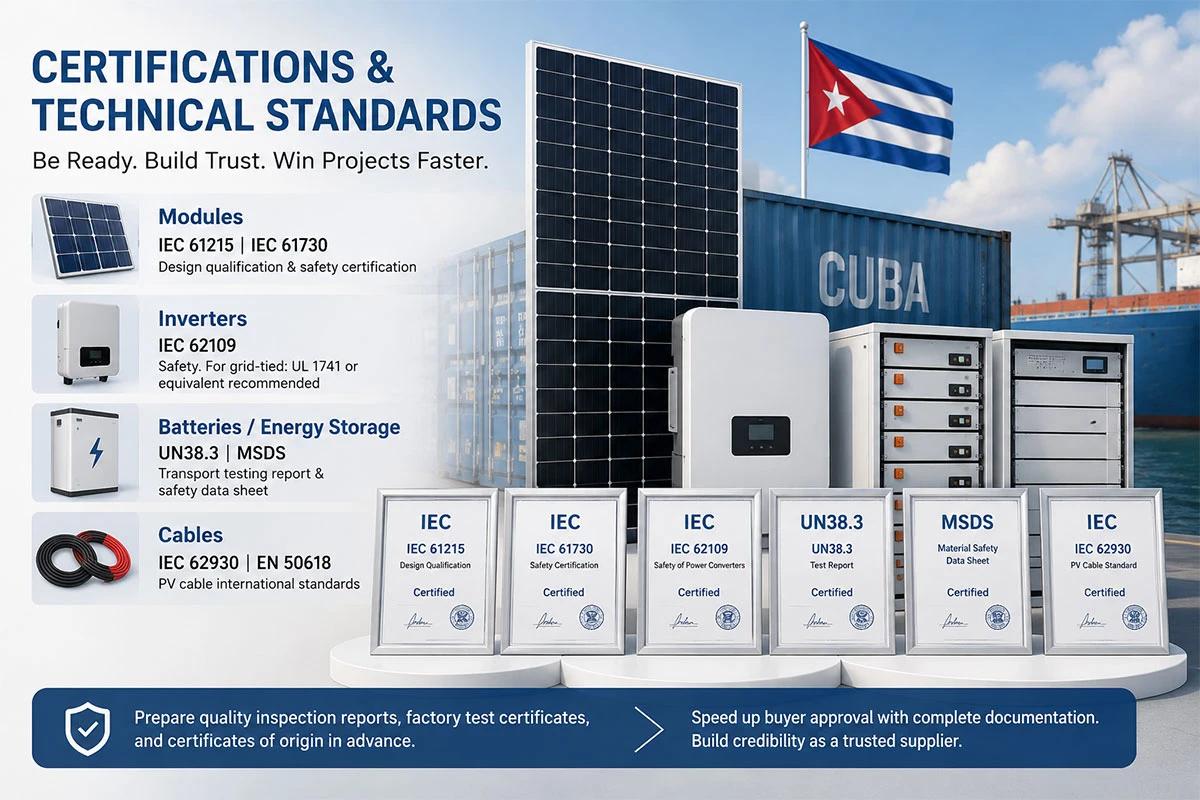
Cuba does not yet have a fully independent domestic certification system for solar products. In practice, actual acceptance and tender processes generally reference mainstream international standards, and specific requirements should be confirmed with each buyer individually. Commonly referenced standards include:
Modules:
IEC 61215 (design qualification), IEC 61730 (safety certification)
Inverters:
IEC 62109 (safety); for grid-tied models, it's advisable to also have documentation aligned with UL 1741 or an equivalent grid-interconnection certification
Batteries / energy storage:
UN38.3 transport testing report, MSDS safety data sheet (mandatory for both air and sea shipment of lithium batteries)
Cables:
IEC 62930 or EN 50618
Even though Cuban customs may not mandate these certificates, buyers typically need to submit technical compliance documentation when applying to ONURE for grid-connection approval or duty-exemption status. Preparing quality inspection reports, factory test certificates, and certificates of origin in advance will significantly speed up your buyer's approval process - and is a key way to establish your credibility as a supplier.
Documentation Checklist: A Complete Set Saves Clearance Time
Core documents commonly required for cross-border solar equipment trade include:
Commercial invoice (listing model, specification, quantity, and unit price; HS codes should be as precise as possible - inverters, modules, and batteries fall under different subheadings, and misclassification can lead to tariff disputes)
Packing list (gross/net weight, packaging dimensions; battery products must indicate UN number and packing group)
Bill of lading / transport documents
Certificate of origin (there is currently no preferential tariff agreement between China and Cuba, but a certificate of origin is still a standard customs declaration requirement)
Quality inspection certificate / type test report
Duty-exemption documentation, where applicable: a copy of the buyer's ONURE technical approval or corresponding duty-exemption approval, obtained in advance. Confirm with the buyer before shipment whether all clearance documentation is in place, to avoid port delays and additional storage costs from incomplete paperwork on arrival.
Logistics: Choosing the Right Freight Forwarder Matters More Than Choosing the Cheapest One
Cuba sits at the northwestern edge of the Caribbean Sea and has port infrastructure including the Port of Havana. Shipments from China to Cuba generally move by ocean freight, often transiting through hubs outside the United States (such as Kingston, Jamaica, or Panama). Common practices include:
Choose a freight forwarder with actual, ongoing experience on Cuba routes. Prioritize forwarders with a long track record of handling Cuba shipments and clear knowledge of which shipping lines and insurers will actually accept bookings, rather than a generalist forwarder offering a one-off quote - this significantly reduces the risk of discovering after booking that the shipment can't actually move.
Confirm destination port handling capacity in advance. Cuban port infrastructure is aging, and on-arrival unloading and storage capacity is limited. For solar panels and battery shipments, confirm moisture- and shock-protection packaging requirements with your forwarder ahead of time.
Battery products: Lithium batteries must be shipped in compliance with dangerous goods regulations, with a UN38.3 report required for sea freight, to avoid cargo being held for inspection at the destination port.
Insurance: Cargo transport insurance is advisable. Given Cuba's aging grid infrastructure and limited port handling conditions, the level of uncertainty in the transport process is relatively higher than in many other markets.
Practical Payment and Settlement Recommendations
Given the compliance considerations discussed above, common approaches include:
RMB settlement:
Cross-border RMB settlement is now available nationwide, with a process largely similar to USD settlement, while effectively avoiding the heightened scrutiny built into the USD clearing pathway. At present, this is a relatively more reliable option for Cuba-related trade.
Staged payment:
Given that Cuba's foreign exchange reserves are tight and buyers' payment capacity can be constrained, structures such as "deposit + balance before shipment" or letters of credit - which provide some payment security - are advisable, rather than full open-account terms.
Exercise caution with extended payment terms / credit requests:
Cuban buyers, constrained by domestic foreign exchange controls, may request extended payment terms. This should be assessed carefully based on the buyer's creditworthiness and order size, with export credit insurance considered as a way to spread risk where needed.
Summary of Key Risk Points
|
Stage |
Main Risk |
Recommended Response |
|
Bank settlement |
Domestic bank refuses / reverses payment |
Confirm with bank in advance; prioritize RMB settlement |
|
Buyer qualification |
Unauthorized intermediary with no real purchasing authority |
Verify MIPYME/state enterprise registration and authorization documents |
|
Customs clearance |
Missing duty-exemption approval / technical certificates causes port delays |
Confirm ONURE approval and full documentation with buyer before shipment |
|
Transport & logistics |
Shipping lines / insurers decline Cuba routes |
Use a freight forwarder with established Cuba route experience |
|
Product acceptance |
Lack of international certification documentation delays grid-connection approval |
Prepare IEC/UN38.3 and related test reports in advance |
|
Payment security |
Buyer's foreign exchange constraints / payment default risk |
Deposit + balance in stages; assess credit terms cautiously |
Closing Thoughts
Cuba's solar market is currently at a point where favorable policy and genuine demand are converging - but it is also one of the most compliance-intensive markets in global trade. The distributors who succeed long-term in this market are typically not the ones offering the lowest prices, but those with the most complete documentation, the clearest compliance process, and the most stable logistics and banking channels.
If you are evaluating entry into Cuba's solar market, or already have a buyer but are stuck on settlement, customs clearance, or certification, feel free to reach out to us through our website - we can provide further support on sourcing and compliance based on your specific project.
This content is compiled from publicly available information for reference only and does not constitute legal or financial advice. Cuban policy is subject to frequent change; please rely on the latest official documents and professional legal counsel for specific transactions.