



Buying Chinese Solar Products for Ukraine: A Practical Procurement Guide
Quick Answer
Why buy from China: the value is not only price. It is a complete supply chain, a choice of technologies (TOPCon, BC), modules, inverters and batteries from one source, OEM/ODM customisation, and the capacity for large orders and long-term supply.
What to buy: start with the application (home rooftop, C&I rooftop, ground-mounted plant, off-grid backup), then choose the combination of modules, inverters and storage.
How to choose a supplier: first tell manufacturers from traders, then verify business licence, certificates, export records, samples and pre-shipment inspection one by one. A ready-to-use supplier verification checklist is included below.
In Ukraine, outages and an unstable grid have pushed many buyers to treat backup power and storage as seriously as energy yield. That changes how solar equipment should be bought. This guide takes a procurement view and answers three questions: why buy from China, what to buy for each type of project, and how to find and verify a reliable supplier.
1. Why Ukrainian Buyers Source Solar Products from China
Price is part of the answer, but for buyers running real projects, the following five points matter more.
1.1 A complete supply chain makes spec changes and traceability easier
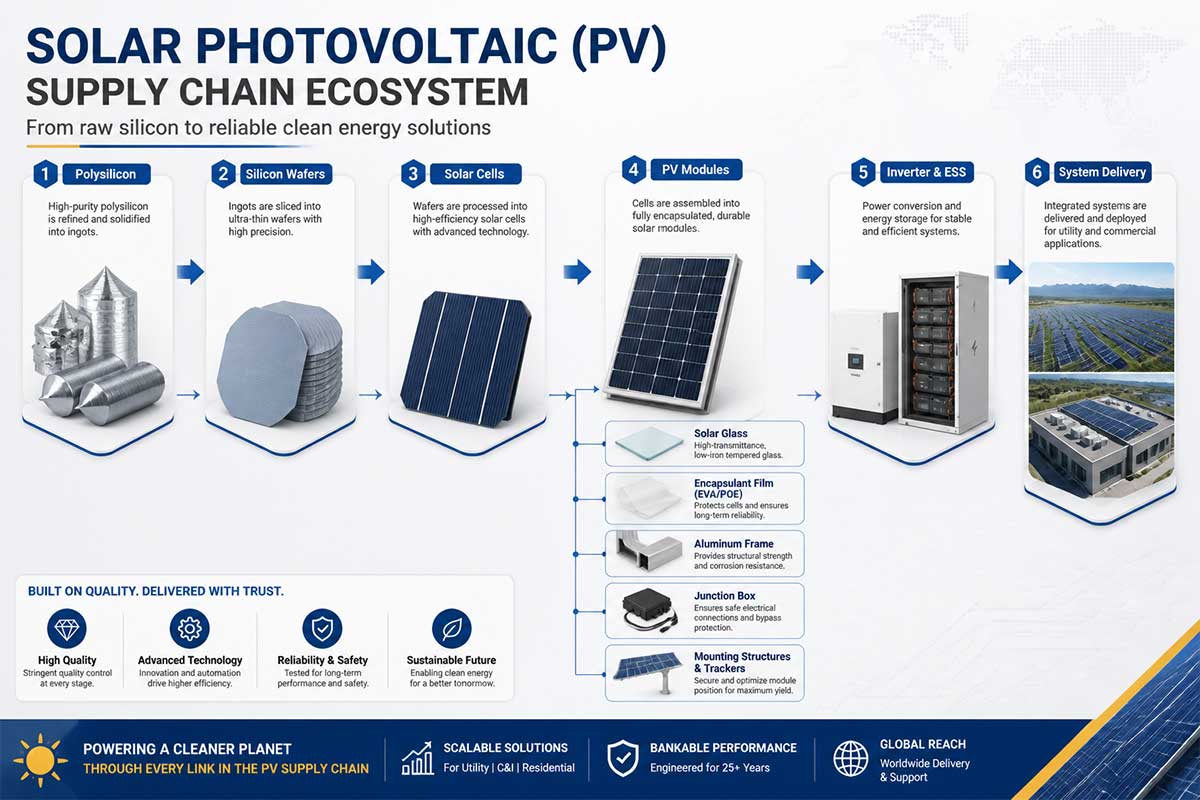
From polysilicon, wafers and cells to modules, solar glass, encapsulant, frames, junction boxes, inverters, battery cells and mounting structures, China has established suppliers at nearly every step. For a buyer, this brings three direct benefits:
Faster spec changes. Requests such as a different glass thickness, frame colour or cable length can usually be handled with existing component suppliers, without new development.
Alternatives when materials run short. If one auxiliary material is unavailable, a well-run factory can switch to an approved alternative brand.
Problems can be traced to the source. Factories with good records can trace a faulty module back to a specific cell batch and material batch.
1.2 Several technology routes, chosen by project rather than locked to one product
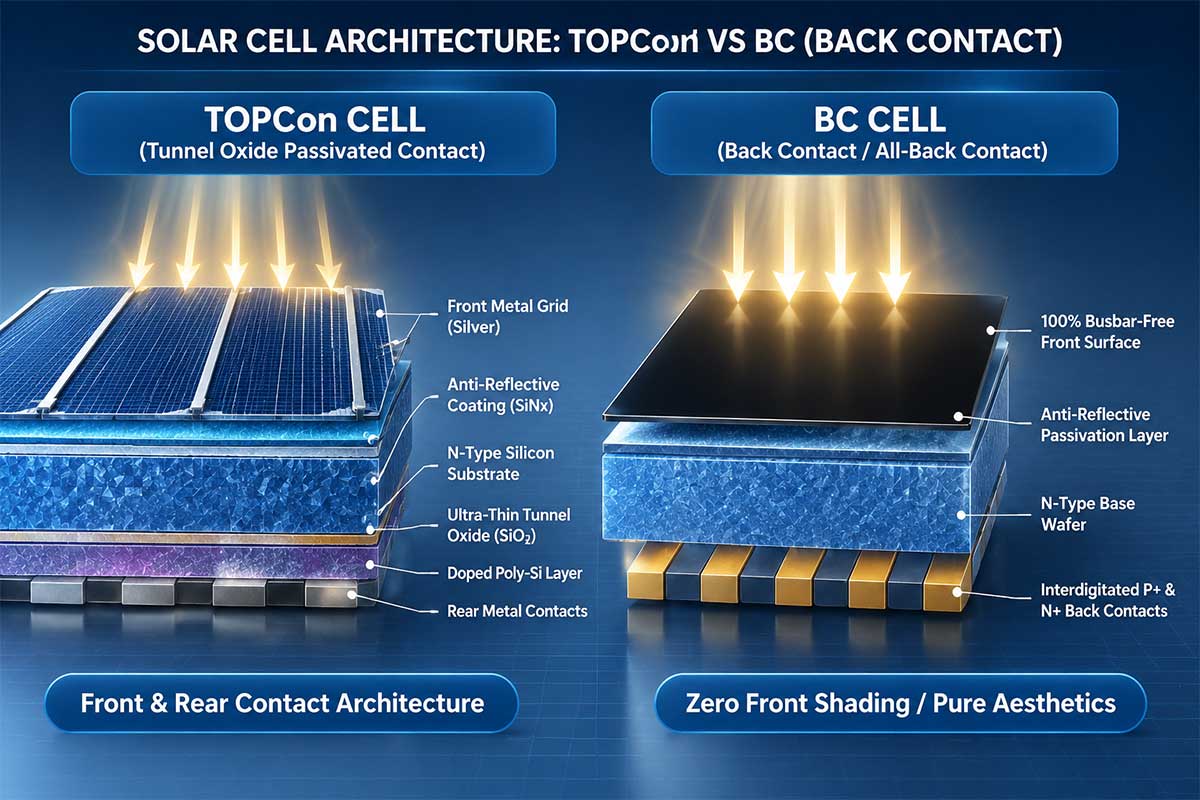
TOPCon (tunnel oxide passivated contact) is currently the mainstream mass-produced module technology among Chinese manufacturers, and several manufacturers also produce BC (back contact) modules. The two routes differ in product format, pricing and availability; see Part 2. Ask suppliers to quote both for the same project and compare them, rather than ordering because only one option was on the table.
1.3 Modules, inverters and batteries from one source
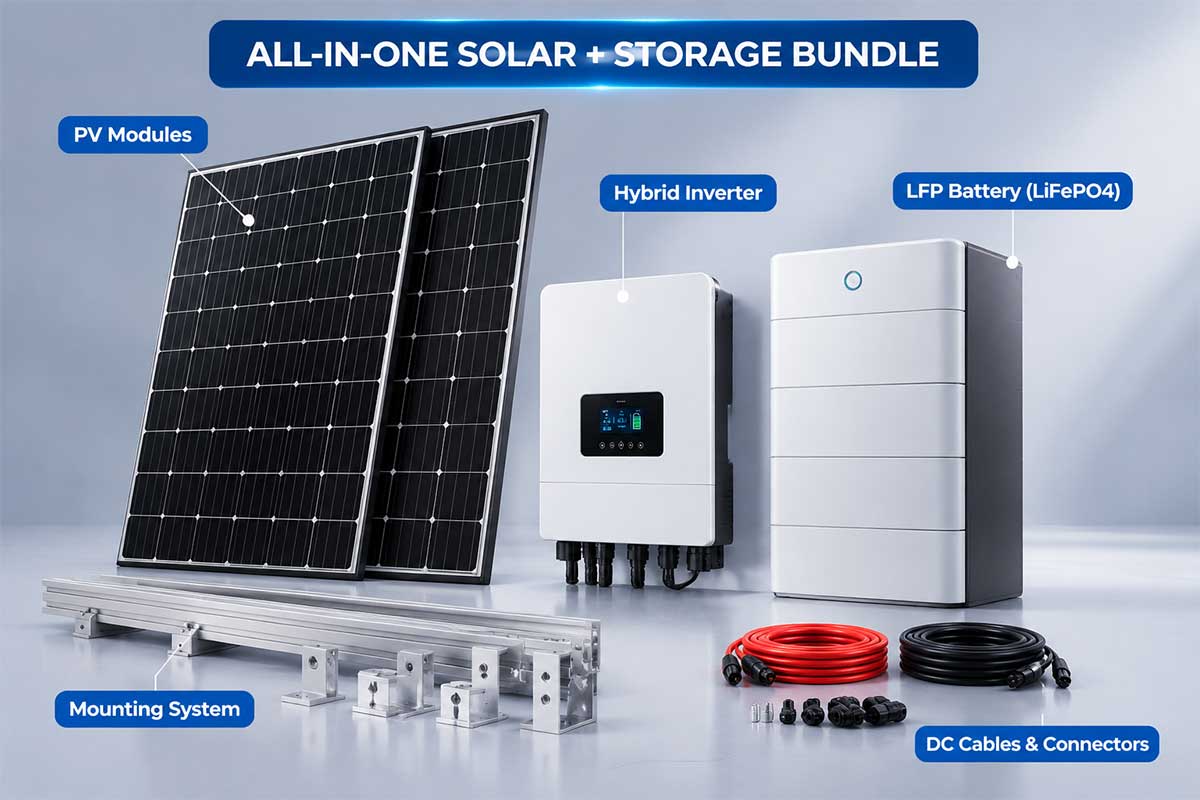
In residential and C&I storage projects, modules, hybrid inverters and batteries have to work together. Buying them from one supplier or one supply network means one contract, one inspection and combined container loading, and a single party confirms communication compatibility between the inverter and the battery.
One caution: "one-stop" does not mean everything is made in-house. Before ordering, ask which products the supplier makes itself, which come from partner brands, and who carries the warranty.
1.4 OEM, ODM and customisation
The three terms mean different things:
OEM: the factory's existing design with your brand and model name on it.
ODM: the factory provides the design platform, you choose the configuration and sell under your own brand.
Customisation: adjustments to an existing product, such as power class, all-black appearance, cable length, connector type, nameplate and manual language (English or Ukrainian), carton marking and packaging.
Put every customisation into the contract and confirm three points: the minimum order quantity; whether certificates are updated after a brand change (the certificate holder details usually need to match, so check with the factory and the certification body); and who owns the intellectual property of the brand and design.
1.5 Large volumes and long-term supply
Utility-scale and large C&I projects are usually delivered in batches, and the same specification must stay available for months. When evaluating a supplier, look beyond the quote: annual capacity and actual shipment volume, current order backlog, willingness to sign a framework agreement with a price-adjustment mechanism, and whether specification changes are notified in writing in advance.
1.6 Buying directly from China vs. buying through European channels
"European channels" here means buying from European distributors or local warehouses. Either way, the goods must clear Ukrainian customs. Also note that many solar products in European warehouses are made in Chinese factories too, so the difference lies mainly in the sales channel, not in production.
|
Factor |
Buying directly from China |
Buying from European distributors or warehouses |
|
Cost structure |
Factory price plus international freight, insurance, duties, VAT and clearance fees. Fewer middle layers, but you calculate the landed cost yourself. |
The price includes the distributor's margin and warehousing; some logistics may already be included, depending on the quote terms. |
|
Lead time |
Covers production or stock preparation, international transport and customs. The overall cycle is longer and needs advance planning. |
Faster when goods are in stock; out-of-stock or unusual models must wait for replenishment. |
|
Product range |
Wider range of models, power classes and technology routes; customisation possible. |
Mostly limited to the distributor's stock and represented brands. |
|
Order quantity |
Modules are usually quoted per pallet or container; the exact minimum is set by the supplier. |
Small quantities are possible, which suits restocking and trial orders. |
|
Customisation |
OEM/ODM, appearance, nameplate and packaging are negotiable. |
Generally not available, or limited to standard products. |
|
After-sales and warranty |
Claims are cross-border, so response method and local service partner should be agreed in the contract. |
The claim counterparty is in Europe and the path is shorter, but you still need to confirm that the warranty covers installation sites in Ukraine. |
|
Payment and cash tied up |
Staged payments are common, and cash is tied up for longer. |
Payment terms vary by distributor; some may offer credit terms. |
|
Compliance and documents |
You prepare, or ask the supplier to provide, certificates, proof of origin and customs documents. |
Distributors usually supply certificates used in the EU market, but Ukrainian compliance requirements still need to be confirmed separately. |
On pricing: this guide does not quote fixed price differences. Prices for modules, batteries and inverters move with raw materials, exchange rates, freight and trade policy, and different specifications and technology routes cannot be compared directly. When comparing quotes, ask every party to quote on the same specification, the same Incoterms and the same warranty terms, then convert to landed cost:
Landed cost = ex-works or FOB price + international freight and insurance + import duties and VAT + clearance, storage and domestic transport + cost of tied-up capital + quality-risk allowance
The applicable duty and VAT rules should be confirmed with Ukrainian customs and your customs broker.
2. Which Solar Products Should Ukrainian Buyers Choose?
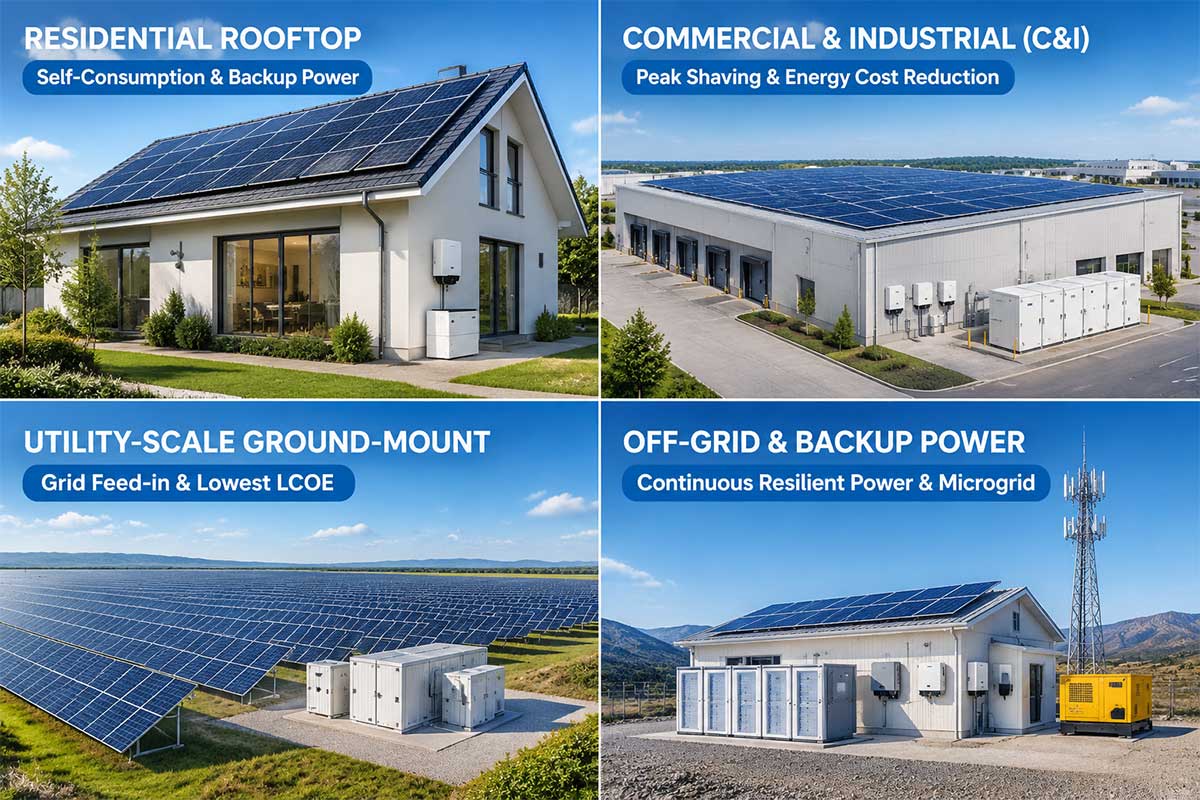
Start with the application, then choose the product. Two 10 kW systems can have completely different configurations depending on whether the goal is rooftop generation, outage backup or commercial self-consumption.
|
Application |
Recommended configuration |
What to check |
|
Home rooftop |
Modules + hybrid inverter + LFP (lithium iron phosphate) battery |
Roof area and load capacity; backup capability (EPS output power and switchover time); battery capacity sized to critical loads; low-temperature charging limits. |
|
C&I rooftop |
High-power modules + three-phase inverter + storage |
Load profile and self-consumption share; roof loading; three-phase load balance; monitoring and remote maintenance; grid connection requirements. |
|
Ground-mounted plant |
High-power bifacial modules + central or string inverters |
System cost per watt; whether bifacial gain suits site ground conditions; mounting and installation efficiency; long-term supply and batch consistency; snow and wind loads. |
|
Off-grid and backup power |
Storage battery + hybrid inverter + backup generator |
Generator input and automatic switchover; battery capacity and discharge power; cold environments; start by listing critical loads. |
Ukraine's climate and grid conditions raise a few points that should be considered at the selection stage:
Cold winters and snow: check the module's mechanical load rating (snow and wind). LFP batteries are usually restricted from charging at low temperatures, so choose a battery with heating where needed, or install it indoors.
Frequent outages: check the inverter's switchover time after grid loss, its off-grid output power, and whether it can start motor loads (refrigerators and pumps draw high starting current).
Grid connection: inverters must meet the local grid operator's connection rules. Confirm with the grid operator or a certification body before ordering.
2.1 TOPCon vs. BC modules: what is the difference?
|
Factor |
TOPCon |
BC (back contact) |
|
Structure |
n-type cell with a tunnel oxide passivated contact on the back and metal gridlines on the front. |
All electrodes are on the back of the cell; no gridlines on the front. |
|
Appearance |
Gridlines visible on the front; all-black versions also exist. |
Uniform, clean front face, suited to rooftops where appearance matters. |
|
Power per area |
Mainstream level, with many models available. |
Some products deliver higher power on the same area, which suits projects with limited roof space. |
|
Product formats |
Monofacial, bifacial, single-glass and dual-glass formats are all available. |
Fewer formats; confirm for each specific model. |
|
Price positioning |
Wide price range with many value-oriented options. |
Usually positioned higher; rely on actual quotes. |
|
Number of suppliers |
Many. |
Fewer; confirm capacity and lead time. |
|
Typical use |
Ground-mounted plants, C&I rooftops, most home rooftops. |
Projects with tight roof space, a focus on appearance, and willingness to pay for higher power per area. |
Buying advice: do not decide by technology name alone. Ask the supplier for the datasheet of the specific model, temperature coefficient, degradation rate, bifaciality (if applicable) and third-party test reports, then compare energy yield and system cost for the same application.
2.2 Power rating and module size
Higher module power comes from two sources: better cell efficiency and a larger module area. Larger modules are heavier, so handling, roof loading, mounting design and installation crews all need to be reassessed. When choosing, look at the following:
Compare power per area (W/m²), not only nominal power. This figure says more when roof space is limited.
Check that module dimensions fit the mounting system and roof layout, and how many modules fit in a container, which affects logistics cost per watt.
Check the inverter's input specifications. High-power modules usually carry higher current, so confirm that the inverter's maximum input current and MPPT voltage range can cover it.
For ground-mounted projects, focus on system cost per watt and installation efficiency rather than the highest single-module power.
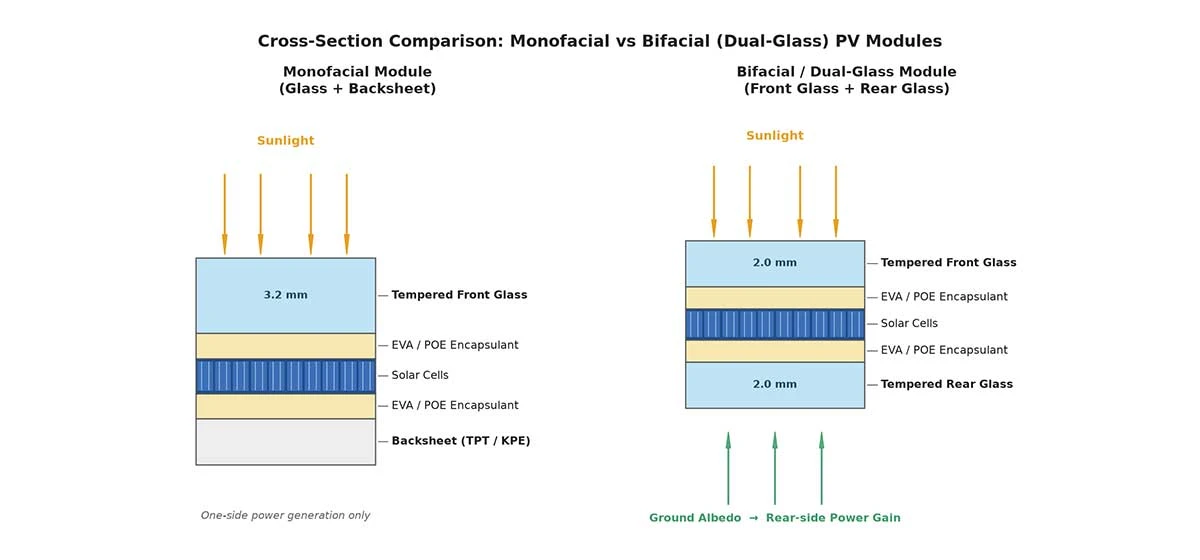
2.3 How to choose between single-glass and dual-glass, monofacial and bifacial
|
Factor |
Single-glass (glass + backsheet) |
Dual-glass |
|
Weight |
Lighter, suited to roofs with limited load capacity. |
Heavier, with higher handling and mounting requirements. |
|
Weather and moisture resistance |
Depends on the quality of the backsheet material. |
Glass on the back is usually more resistant to moisture and abrasion. |
|
Rear-side generation |
Generally monofacial. |
Commonly used for bifacial modules, where the rear side also generates power. |
|
Cost |
Usually lower. |
Usually higher. |
|
Typical use |
Lightweight roofs and budget-sensitive projects. |
Ground-mounted plants, humid environments and projects that need bifacial generation. |
Bifacial gain depends on ground reflectance, mounting height, tilt and row spacing. Snow-covered ground reflects more light and may add rear-side output, but snow cover on the front face and the effort to clear it must also be considered. On flat roofs, the gain is usually limited. Ask for the test conditions behind any gain figure a supplier quotes, and do not use it directly in revenue calculations.
3. How to Find and Screen Reliable Chinese Solar Suppliers
There is no shortage of ways to find suppliers: trade shows, B2B platforms, peer referrals and industry association directories. The hard part is confirming who they are, what they can do and whether they will take responsibility when something goes wrong. Verify them in the six areas below.
3.1 Manufacturer or trader?
A trader is not necessarily a bad choice. Some can combine several factories and offer more flexible service. What matters is that they are honest about what they are. Here is how to tell:
Check the business scope on the business licence. Manufacturers usually list "production" or "manufacturing", but this is a hint only, not proof.
Check that the factory address matches the address on the business licence and on the certificates.
Ask for a live video tour. Have them show a specified production line and warehouse, and hold up a note with your inquiry number or today's date.
Ask technical questions. A real producer can explain cell sourcing, the lamination process, test stages and how defect rates are controlled.
Look at the certificate holder. If it is not the same company as the one quoting, ask how the two are related.
3.2 How to verify actual production capacity
Request monthly capacity, number of production lines, main equipment brands and order backlog, and cross-check them against the claimed shipment volumes.
Ask whether core materials are made in-house or bought in. Many module makers buy their cells, and inverter chips or battery cells may also be sourced externally. That is not a problem, but you must know the source, write it into the contract and require notice of any change.
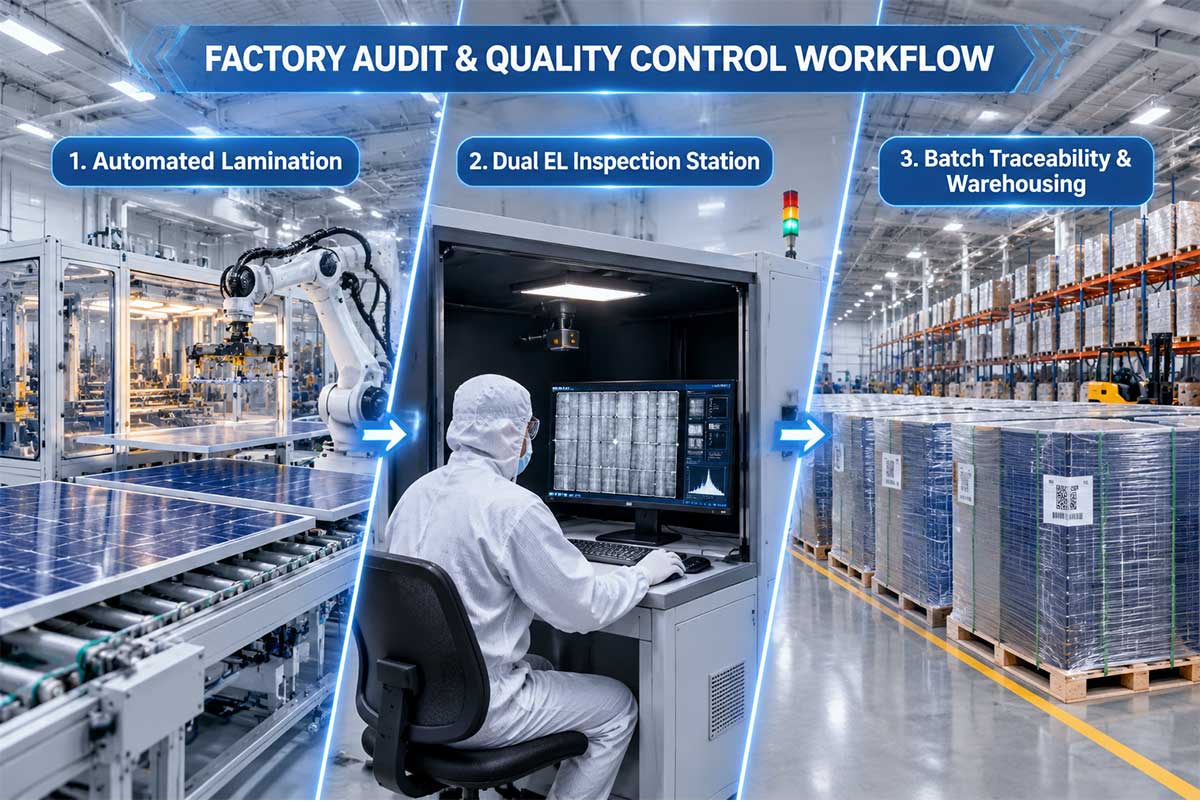
For large orders, have a third party (such as SGS, TÜV, Bureau Veritas or Intertek) audit the factory, or send a trusted agent in China to visit on site.
3.3 How to check the business licence and export record
Use the Unified Social Credit Code to look up the company on China's National Enterprise Credit Information Publicity System: registration status, date of establishment, registered capital, and any business anomalies or administrative penalties.
Check that the contract party, invoice name and bank account holder all match. A bank account that does not match the contracting party is a common red flag.
Confirm that the company is registered with customs and qualified to export.
Ask for recent export records, such as bills of lading or customs declarations (customer details may be masked), and whether they have shipped to Europe or countries neighbouring Ukraine. Cross-check through a third-party trade data service.
Ask for one or two existing customers you can contact as references.
3.4 How to confirm a product is made by the factory itself
Certificates: modules should normally hold IEC 61215 (performance) and IEC 61730 (safety); inverters commonly IEC 62109-1/-2, and grid-tied models must also meet local grid rules (for example EN 50549, subject to the grid operator's requirements); storage batteries commonly IEC 62619, and sea freight needs a UN 38.3 test report.
Verify certificates: confirm that the holder is the manufacturer, that the certified models include the one you are buying, that the certificate is valid, and check it on the issuing body's website.
Match nameplates and serial numbers: manufacturer name, address and model on the nameplate should agree with the certificate, and module serial numbers should be traceable.
Ask for data: request factory test data (such as per-module power test sheets), samples and third-party test reports.
On Tier 1: it is a reference commonly used by lenders, not a guarantee of quality. Also look at independent reliability test results, such as the PV Module Reliability Scorecard published by Kiwa PVEL.
3.5 Does the supplier have stable export delivery capability?
Ask about experience shipping to European markets, including packaging (pallets, full-container loading, moisture and shock protection) and paperwork (commercial invoice, packing list, proof of origin, product certificates).
Lithium batteries are dangerous goods in transport. Confirm that the supplier and the freight forwarder have experience and can provide the UN 38.3 report and related transport documents.
Routes and transit times depend on conditions at the time. Confirm the route, expected time and insurance coverage with your forwarder, and state the split of responsibility in the contract under Incoterms (such as FOB, CIF or DAP).
Require a pre-shipment inspection; see the checklist below.
3.6 Does the supplier offer long-term technical support and after-sales service?
Read the warranty terms in full: product warranty period, power warranty period, whether the warranty covers installation sites in Ukraine, and who handles claims.
Ask for the claim process and response times in writing, and whether there is an authorised service partner or spare-parts warehouse in Europe or Ukraine.
For inverters and batteries, confirm the monitoring platform, firmware updates and the language of technical documents (English or Ukrainian).
Request the list of battery models compatible with the inverter, so that the units can communicate after delivery.
3.7 Supplier Verification Checklist
Go through this list before placing an order. Each item should be backed by written documents.
|
Item |
Documents to request |
Pass criteria |
Result |
|
Legal entity |
Business licence, Unified Social Credit Code |
Found on the National Enterprise Credit Information Publicity System, status normal, name matches contract and bank account |
☐ |
|
Business scope and identity |
Business scope, factory address |
Scope includes manufacturing; address matches the audited site |
☐ |
|
Factory reality |
Dated live video, or third-party audit report |
Can show the line and warehouse linked to your order |
☐ |
|
Capacity |
Monthly capacity, number of lines, order backlog |
Supports your volume and lead time with some margin |
☐ |
|
Core material sources |
List of main sources for cells, battery cells, chips, etc. |
Sources are clear; changes require advance written notice |
☐ |
|
Product certification |
IEC and other certificates, test reports |
Holder is the manufacturer, covers the model, verifiable with the issuing body |
☐ |
|
Ukrainian compliance and grid connection |
Local compliance requirements, grid operator connection rules |
Confirmed with a local certification body, grid operator or customs broker |
☐ |
|
Export record |
Recent bills of lading or customs declarations (customer details may be masked), customer cases |
Has shipped to Europe or neighbouring countries |
☐ |
|
Sample testing |
Samples, power test and EL results; capacity test for batteries |
Deviation from the datasheet is within the contract tolerance |
☐ |
|
Warranty and after-sales |
Written warranty terms, claim process, local service partner |
Terms are clear and response times are in writing |
☐ |
|
Contract and payment |
Draft contract, payment method |
No full prepayment, staged payments, quality dispute handling defined |
☐ |
|
Pre-shipment inspection |
Third-party inspection report |
Quantity, model, appearance, serial numbers and packing checked before shipment |
☐ |
|
Long-term supply |
Framework agreement, price-adjustment mechanism, stocking plan |
Specification changes notified in writing; batch sources stay stable |
☐ |
Pause the deal if you see any of the following
The quote is far below the market for the same specification and the supplier cannot explain why.
They refuse a video tour or a third-party audit.
They demand full prepayment, or the bank account does not match the contracting party.
The certificate holder is unrelated to the quoting company and they will not explain.
The sample does not match the datasheet, yet they promise that "the bulk order will be different".
They are vague about the warranty and the claim process.
4. From Inquiry to Delivery: The Procurement Process
Define the requirement: application, capacity, budget, certification requirements and delivery date.
Quote on equal terms: ask at least three suppliers, using the same specification, the same Incoterms and the same warranty.
Audit the shortlist: verify each supplier item by item using the checklist above.
Samples and testing: power and EL (electroluminescence) tests for modules, capacity tests for batteries, and parallel-operation and communication tests for inverters.
Sign the contract: specification, price, lead time, payment, warranty, liability for breach and notice of specification changes should all be written clearly. Use staged payments and avoid full prepayment.
Follow production and inspect before shipment: a third party samples the goods and checks quantity, model, packing and serial numbers.
Logistics and customs clearance: confirm HS codes, certificates and document requirements in advance with the forwarder and a Ukrainian customs broker.
Inspect on arrival: check appearance, quantity and damage, raise objections within the period set in the contract, and keep photos and records.
5. Frequently Asked Questions
Is TOPCon or BC better for a home rooftop in Ukraine?
Both can work, depending on roof area, budget and appearance requirements. When the roof is large enough and the budget is limited, TOPCon offers more choice and better value. When roof space is tight or appearance matters, include BC modules in the comparison. Either way, compare the datasheet and test reports of the specific models.
How can I tell whether a supplier is a factory or a trader?
Check the business scope and factory address on the licence, ask for a live video tour, verify the certificate holder and ask technical questions. Working with a trader can be fine, but make them state clearly who they are and who actually makes the goods.
What should I watch for when buying storage batteries?
Check the cell type first (LFP is common in home and C&I storage), then the inverter compatibility list, low-temperature charging limits, the UN 38.3 transport report, warranty terms and the test conditions behind the cycle-life figures. Where winters are cold, confirm how the battery operates at low temperatures.
What is the usual minimum order quantity?
Modules are usually quoted per pallet or container, and inverters and batteries per unit or set. The exact minimum is set by the supplier and is usually higher for customised products. State your required quantity in the inquiry, and whether you accept shared containers.
How should payment be arranged?
Avoid paying in full in advance. A common approach is staged payment: a deposit, payment after the pre-shipment inspection is passed, and a final balance after arrival and acceptance, with the exact split negotiated by both sides. A letter of credit is also an option, but confirm the bank and fees beforehand.
Summary
The value of sourcing solar products from China lies in supply-chain depth, technology choice, one-stop supply, customisation and long-term supply. These advantages turn into real returns only after you choose the right supplier, write a clear contract and inspect the goods. The suggested order: define the application first, verify suppliers with the checklist, then compare landed costs on the same basis.
sale7@jingsun-solar.com
Solar Power System
Disclaimer: this guide is for procurement reference only and does not constitute legal, tax or customs advice. Duties, VAT, product certification and grid connection requirements are subject to current Ukrainian regulations and the competent authorities. Confirm with a local customs broker, certification body and grid operator before ordering.