


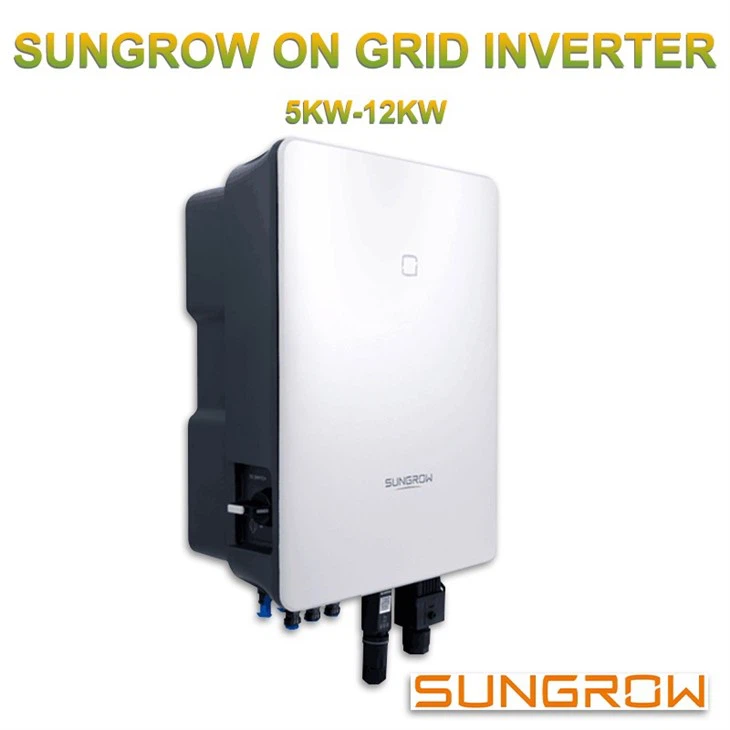
Product Advantages
SUNGROW's SG10RT grid-tied inverter has various advantages that make it stand out in the market. Here are five reasons why it is a preferred choice for many:
1. Lower Startup And Wider MPPT Voltage: The SG10RT has a lower startup voltage and a wider maximum power point tracking (MPPT) voltage range than many other inverters in its class. This means the system can start producing power even in low-light conditions and can extract more power from the solar modules.
2. Smart IV Curve Scanning: This inverter utilizes smart IV curve scanning technology that enables it to scan the entire system and adjust the voltage and current to reach the maximum power output of the solar modules. This maximizes energy yield and optimizes the system's performance.
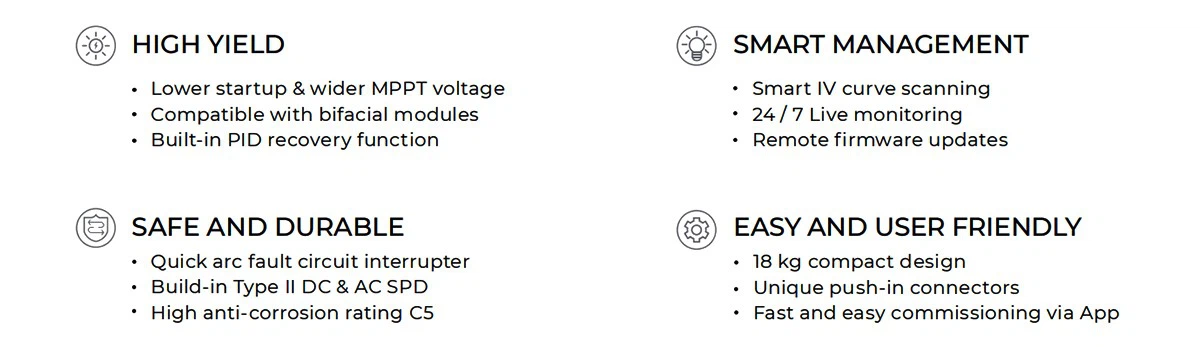
3. Quick Arc Fault Circuit Interrupter: The SG10RT is equipped with a quick arc fault circuit interrupter that provides rapid protection against electrical arcs. This feature increases the safety of the system and helps to prevent electrical fires.
4. Fast And Easy Commissioning Via App: The SG10RT can be easily and quickly commissioned using the SUNGROW app. This makes the setup process simpler and ensures that the system is up and running in no time.
5. High Reliability And Durability: SUNGROW is known for producing inverters that are highly reliable and durable. The SG10RT is no exception. It is built to withstand harsh environments and is backed by a comprehensive warranty and support. This ensures that the system will provide continuous power for years to come.
In conclusion, the SG10RT is a high-performance and reliable grid-tied inverter that comes packed with advanced features and technology. It is an excellent choice for anyone looking to invest in a solar energy system that delivers optimum performance and value for money.
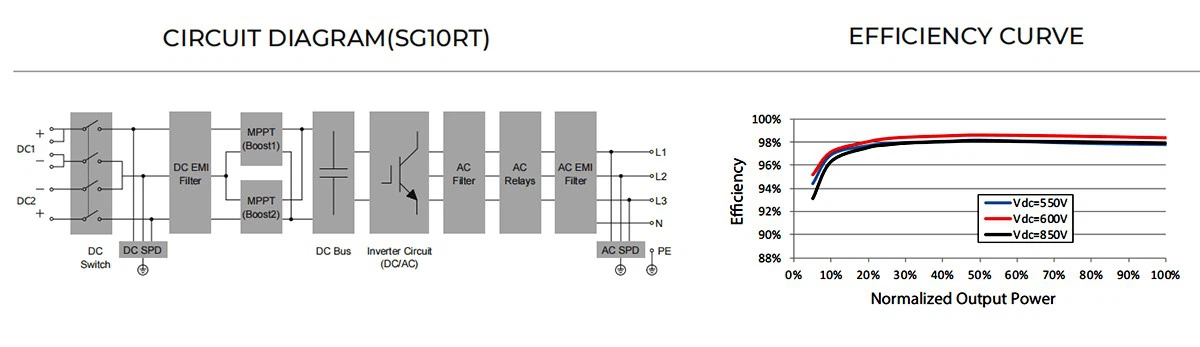
Technical Data
|
Type Designation |
SG5.0RT |
SG6.0RT |
SG7.0RT |
SG8.0RT |
SG10RT |
SG12RT |
|
Input (DC) |
||||||
|
Recommended max. PV Input Power |
7.5 kWp |
9.0 kWp |
10.5kWp |
12 kWp |
15 kWp |
18 kWp |
|
Max. PV Input Voltage |
1100 V |
|||||
|
Min. PV Input Voltage / Start-up Input Voltage |
180V / 180V |
|||||
|
Rated Input Voltage |
600 V |
|||||
|
MPP Voltage Range |
160 V – 1000 V |
|||||
|
No. of Independent MPP Inputs |
2 |
|||||
|
No. of PV Strings Per MPPT |
1/1 |
1/1 |
2/1 |
2/1 |
2/1 |
2/1 |
|
Max. PV Input Current |
25 A (12.5 A / 12.5 A) |
37.5 A (25 A / 12.5 A) |
||||
|
Max. DC Short-circuit Current |
32 A (16 A / 16 A) |
48 A (32 A / 16 A) |
||||
|
Max. Current For Input Connect |
30 A |
|||||
|
Output (AC) |
||||||
|
Rated AC Output Power |
5000 W |
6000 W |
7000 W |
8000 W |
10000 W |
12000 W |
|
Max. AC Output Apparent Power |
5500 VA |
6600 VA |
7700 VA |
8800 VA |
11000 VA |
13200 VA |
|
Rated AC Output Apparent Power |
5500 VA |
6600 VA |
7700 VA |
8800 VA |
11000 VA |
13200 VA |
|
Max. AC Output Current |
8.3 A |
10 A |
11.7 A |
13.3 A |
16.7 A |
20 A |
|
Rated AC Output Current(at 230V) |
7.2A |
8.7A |
10.1A |
11.6A |
14.5A |
17.4A |
|
Rated AC Voltage |
3 / N / PE, 220 / 380 V 3 / N / PE, 230 / 400 V 3 / N / PE, 240 / 415 V |
|||||
|
AC Voltage Range |
180V – 276V / 311V - 478V |
|||||
|
Rated Grid Frequency |
50 Hz / 60 Hz |
|||||
|
Grid Frequency Range |
45 - 55 Hz/ 55 - 65 Hz |
|||||
|
Harmonic (THD) |
<3 % (at rated power) |
|||||
|
Power Factor At Rated Power / Adjustable Power Factor |
>0.99/0.8 leading – 0.8 lagging |
|||||
|
Feed-in Phases / Connection Phases |
3 / 3-PE |
|||||
|
Efficiency |
||||||
|
Max. Efficiency |
98.40% |
98.40% |
98.40% |
98.50% |
98.50% |
98.50% |
|
European Efficiency |
97.40% |
97.40% |
97.70% |
97.90% |
97.80% |
97.90% |
General Data

|
Dimensions(W*H*D) |
370*480*195 mm |
|
Weight |
18 kg |
|
Mounting method |
Wall-mounting bracket |
|
Topology |
Transformerless |
|
Degree of protection |
IP65 |
|
Night power consumption |
< 6 W |
|
Corrosion |
C5 |
|
Operating ambient temperature range |
-25 ℃ to 60 ℃ |
|
Allowable relative humidity range (non-condensing) |
0% – 100% |
|
Cooling method |
Natural cooling |
|
Max. operating altitude |
4000 m |
|
Display |
LED |
|
Communication |
WLAN / Ethernet / RS485 / DI / DO |
|
DC connection type |
MC4 (Max. 6 mm² ) |
|
AC connection type |
Plug and play |
|
Grid Compliance |
EC / EN 61000-6-1/2/3/4, IEC 61000-3-2/3/11/12, IEC / EN62109-1/2, IEC 61727, IEC 62116, IEC 61683, IEC 60068-2-1/2/14/30/64/27,IEC TS 62910 , EN50530, AS/NZS 4777.2:2020, VDE-AR-N-4105, DIN VDE0126- 1-1/A1, EN50549-1, DEWA, VFR 2019, UTE C15-712-1, PSE NC RfG, UNE 206006/7 IN, MEA/PEA, G98, UNE 217002:2020, NTS V2 TypeA |
|
Grid Support |
LVRT, HVRT,active & reactive power control and power ramp rate control |

Inverter Appearance

|
No. |
Name |
Description |
|
1 |
Nameplate |
To clearly identify the product, including device model, S/N, important specifications, marks of certification institutions,etc. |
|
2 |
LED indicator |
To indicate the current working state of the inverter. |
|
3 |
Hanger |
Complement to the included wall-mounting bracket for hanging the inverter. |
|
4 |
Label |
Information about COM2 pin definition, supported DRM modes, etc. |
|
5 |
DC switch (Optional) |
To safely disconnect the DC circuit whenever necessary |
|
6 |
Electrical connection area |
DC terminals (SG20RT for example), AC terminal, additional grounding terminal and communication terminals. |
|
7 |
Fans |
Optimization of the inverter’s heat dissipation. Only the SG15RT, SG17RT, SG20RT, SG15RT-P2, SG17RT-P2 and SG20RT-P2 are equipped with fans. |
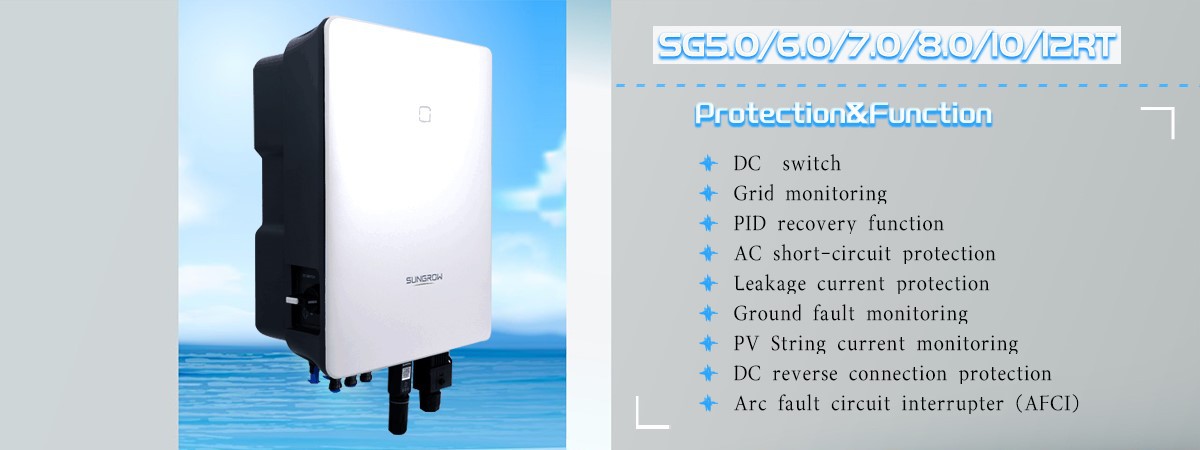
Pay Attention
1. Location
The first and foremost thing is to ensure that the inverter is installed in a suitable location. This will help to ensure that it receives enough ventilation to properly dissipate excess heat. The inverter should also be mounted on a flat surface, protected from direct sunlight, rain, and other environmental factors. The location should also be easily accessible for maintenance and repair purposes.
2. Electrical Connections
It is important to ensure that the electrical connections are properly made. Wires should be connected as per the manufacturer's specifications and the installation manual. Electrical insulation should be used to prevent any accidental short circuits or hazards. Make sure all the electrical connections are properly secured and insulated.
3. Grounding
Proper grounding is also essential. The inverter should always be grounded in accordance with the national regulations. This will help prevent any electrical hazards due to ground faults. Grounding should be done by a qualified electrician since it requires specialized knowledge and equipment.

4. Configuration
Configure the inverter in accordance with the specifications and the user manual. This is considered a prerequisite for successful installation. Incorrect configuration can lead to inefficient performance and dangerous electrical hazards. If you are unsure about the configuration, it is recommended to seek advice from a qualified technician.
5. Maintenance
Finally, maintenance is essential to ensure the inverter continues to function efficiently. Regularly check the electrical connections for corrosion or loose connections. Inspect the cooling fans to ensure they are properly functioning. Clean the exterior of the inverter to prevent any debris from building up on it. Regular maintenance will ensure that the inverter performs efficiently and lasts for many years to come.
FAQ
Q: What is the SG10RT grid-tied inverter and what are its key features?
Q: How does the SG10RT inverter ensure safety during operation?
Q: What is the warranty period for the SG10RT inverter?
Q: Can the SG10RT inverter be connected to a monitoring system for remote management?
Q: How does the SG10RT inverter contribute to a greener environment?
